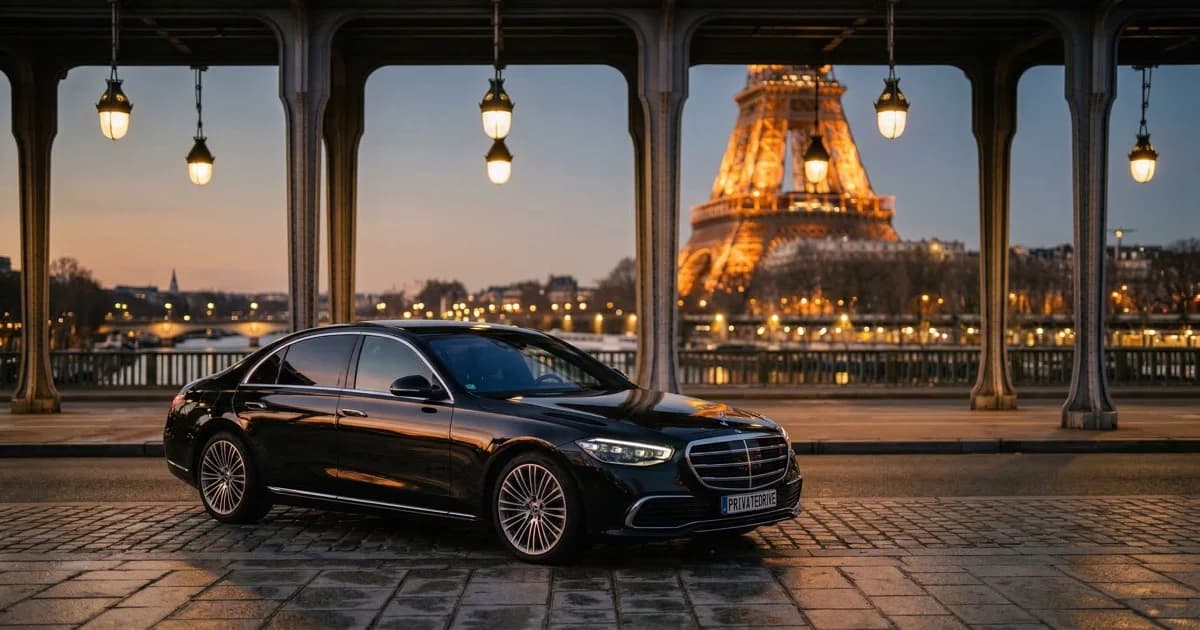
Paris is simultaneously one of the world's most visited cities and one of its most complex urban driving environments. It is home to the heaviest concentration of high-net-worth travellers in Europe, the strictest low-emission vehicle regulations in France, and an airport system that handled 107 million passengers in 2025, its highest-ever traffic figure. The ground transport market serving these three realities is undergoing the most significant structural transformation in a decade.
This study synthesises market data, competitive dynamics, fleet economics, and demand patterns to provide a comprehensive view of Paris luxury ground transport in 2026. It is written for operators, investors, corporate travel managers, and sophisticated travellers who want to understand the market they are navigating.
Market Size and Growth Trajectory
The French luxury travel market was valued at $85.7 billion in 2025, projected to reach $160.4 billion by 2033 at a CAGR of 8.2%. The French luxury car market reached $52.9 billion in 2024, forecast to grow to $79.1 billion by 2030 at a 7% CAGR. The same structural drivers, HNWI wealth concentration, experiential spending, international travel, that expand luxury car purchasing also expand the premium chauffeur market, which sits at the intersection of all three.
There are approximately 40,000 active licensed VTCs in France, of which 80% are concentrated in Île-de-Franc: 32,000 professional vehicles within the Paris region. This concentration creates the supply base for a market that handles over 100 million airport passengers annually and services one of the world's densest concentrations of premium hotels, luxury retail, and corporate headquarters.
One distinction matters for understanding this market: in France, taxis (licensed under the taxi code) can be hailed on the street and have regulated fares, including official flat rates to CDG and Orly airports. VTCs must be pre-booked, price independently, and cannot accept street hails. Both require professional licences; VTC standards have tightened significantly since 2015. The pricing dynamics and booking mechanics of these two categories are entirely different, and are often confused by inbound travellers accustomed to markets where the distinction does not exist.
The VTC Market Structure: Platform vs. Premium
The licensed VTC market in France is structurally bifurcated, and the gap between the two tiers has widened materially over the past three years.
At the platform tier (Uber, Bolt, Heetch, algorithmic dispatch and variable pricing govern the experience. Uber's take rate reached approximately 42% per fare by end-2024 (Columbia Business School study), the highest in the platform's history. This margin compression has driven quality deterioration: lower driver earnings produce higher turnover, which produces less consistent vehicle and service standards. Surge multipliers of 1.5× to 3.5× are common during airport arrival waves, Fashion Week, and major cultural events.
The premium chauffeur tier (PrivateDrive, Chabé, and specialist boutique operators, operates on a pre-booked, fixed-price model. Curated fleets, named background-checked drivers, corporate account capability with consolidated monthly invoicing, flight tracking, and meet-and-greet protocols are standard. No surge pricing applies by design.
The price differential between the two tiers has narrowed significantly in 2024 to 2026 as Uber's surge dynamic inflates effective fares. A CDG-to-Paris transfer theoretically priced at €55 on UberX at 2:00 AM on a quiet Tuesday may cost €110 to €160 during an 08:30 inbound wave, overlapping with, or exceeding, the fixed rate of a private chauffeur service booked 24 hours in advance.
The Electric Transition: Fleet Economics and Market Positioning
The most significant structural change in the Paris premium VTC market is electrification, driven simultaneously by regulation, economics, and client-side demand.
French BEV registrations in 2025 reached 363,130 units (+10.5%), with BEV market share reaching 22.4% in December 2025. first month electric vehicles overtook internal combustion vehicles in monthly sales. France's total electrified fleet exceeded 2.5 million vehicles by end-2025. At 100,000 km/year professional utilisation, an electric vehicle generates €7,000 to €9,000 in annual fuel savings versus a diesel equivalent. The Paris Recharge municipal subscription (€600/year, 1,000+ charging points) makes overnight charging nearly free for city-based operators.
The regulatory dimension is non-negotiable. The Paris ZFE (Zone à Faibles Émissions) bans Crit'Air 3 to 5 vehicles within the Périphérique on weekday daytime hours. Crit'Air 2 vehicles, most post-2011 petrol cars, face additional restrictions from 2026. The French government's objective of 80% electric VTCs by 2026 is accelerating fleet renewal. Premium operators who have not electrified their fleet by 2026 are at a competitive disadvantage on ZFE compliance, fuel cost structure, ESG client criteria, and perceived modernity.
The 2026 premium fleet standard is defined by three vehicle types: the Tesla Model Y and Model 3 dominate the executive tier for cost efficiency; the Mercedes EQS (627 km WLTP range, 118 kWh battery) has become the ultra-luxury EV standard, equalling or exceeding the petrol S-Class on cabin quality; the Mercedes EQV is the only premium electric MPV currently available for group transport (7 seats, 360 km range).
Demand Analysis: Who Is Using Private Transfers in Paris
Inbound leisure, HNWI and ultra-HNWI. Paris received approximately €100 million in tourist spending from top spenders in 2024, with North America and the GCC driving the highest per-capita expenditure. This segment is the core private chauffeur demand: arriving at CDG or Orly, staying at Palace Hotels, and requiring hotel-to-venue transport throughout their stay. CDG handled 72 million passengers in 2025 (+2.5%), while Orly reached 35 million (+5.5%). The Middle East and Asia-Pacific growth vectors represent high-spending segments with above-average private ground transport take rates.
Corporate travel. La Défense houses over 3,500 companies, 150,000 employees, and the European headquarters of most CAC 40 companies and major multinationals. CDG to La Défense represents one of the highest-volume corporate transfer routes in France. Corporate chauffeur accounts are the standard solution for any organisation managing 30+ transfers per month: consolidated invoicing, booking platform access, and a consistent service standard that expense management and duty-of-care policies require.
Events and seasonal peaks. Paris Fashion Week (March and September) generates +40 to 60% premium hotel ADR, 100,000 industry visitors, and 300+ chauffeur transfers from the opening show alone. The Paris Air Show at Le Bourget concentrates aviation VIP transfers in odd years. An underestimated segment: Paris's resident HNWI population, estimated at 60,000 to 80,000 individuals with net worth above €10 million, uses private chauffeur as a recurring lifestyle service for school runs, evening restaurant transfers, and shopping along Avenue Montaigne.
Pricing: The 2026 Market Rate Card
Airport transfers by private sedan run €95 to €115 fixed from CDG to central Paris, €65 to €75 from Orly, and €120 to €160 from private aviation FBOs at Le Bourget or CDG South. Hourly hire for a standard premium sedan (Mercedes E-Class) runs €60 to €75 per hour with a two-hour minimum; the luxury tier (S-Class, EQS) commands €90 to €120 per hour.
Day excursions follow a distance-duration logic: Versailles half-day at €110 to €140; Champagne day circuit (Reims + Épernay) at €290 to €380; Loire Valley full day at €450 to €600. One structural factor has improved the economics of private transfer for inner-Paris itineraries: since October 2024, Paris doubled parking fees for non-resident SUVs in inner arrondissements to €18/hour in the 1st to 11th. The self-drive-plus-parking calculus is now considerably less competitive compared to private chauffeur for multi-stop Paris days.
Pricing is expected to hold or modestly increase through 2026 to 2027. Electric vehicles reduce fuel costs but carry higher acquisition cost; commercial insurance is rising in France. More significantly, the narrowing gap between Uber's surge-inclusive effective fare and fixed chauffeur rates is reducing price sensitivity in the premium segment.
Competitive Landscape
At the national level, Chabé (established 2010) deploys 100+ chauffeurs per major event and covers Paris, Lyon, and Nice with strong corporate and events positioning. Marcel (Renault-backed VTC) operates a hybrid platform/premium model with partial fleet electrification. Sixt Black brings international car rental scale to the premium chauffeur segment.
Paris-specialist premium operators differentiate on six dimensions: fleet modernity and ZFE compliance; corporate account infrastructure; event coverage capacity; English and multilingual driver capability; fixed pricing and surge immunity; and consistent discretion. Boutique operators of 2 to 20 vehicles serve specific niches, private aviation ramps, Palace Hotel partnerships, recurring residential HNWI accounts. The competitive advantage in this tier is not price; it is reliability at the moment when reliability is most valued.
Structural Outlook: 2026 to 2030
Four trends will define this market through 2030. Continued fleet electrification is the most certain: by 2028, petrol-only premium vehicles will be commercially disadvantaged on both ZFE access and cost structure. Airport traffic will sustain transfer demand, CDG approaching 75 million passengers as Chinese traffic rights resolve; Ligne 17 (the CDG metro, post-2030) will shift budget travellers to rail but has no material effect on premium transfers. AI-assisted logistics will separate efficient operators from reactive ones as predictable surge events are pre-allocated across driver networks. The Uber take-rate ceiling, at 42% globally, creates structural opportunity for fixed-rate dedicated services to capture demand disappointed by platform-tier inconsistency.
The long-run trajectory is bifurcation: the mass market consolidating around platform algorithms, and the premium market consolidating around operators capable of guaranteed service standards, regardless of time or traffic conditions.
PrivateDrive operates Paris's premium-first private chauffeur service, exclusively modern, ZFE-compliant fleet; fixed pricing; corporate and HNWI accounts. Explore PrivateDrive services →