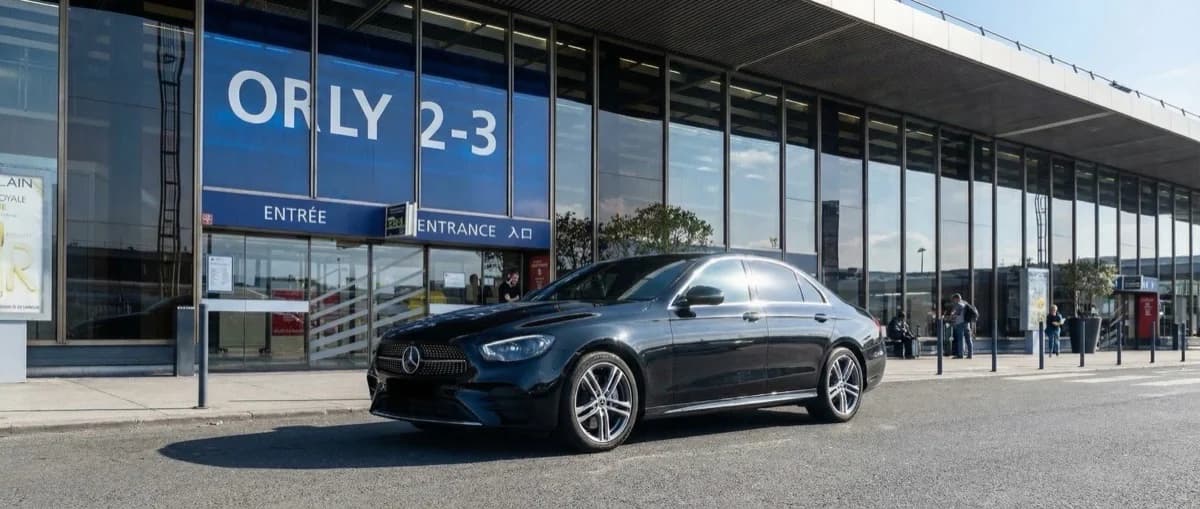
Most passengers arrive at Paris-Orly convinced they know which terminal they need. The confirmation email says "Orly Sud," the taxi app echoes it, and the assumption is a straightforward pickup near Arrivals. Then reality lands: the old "South" and "West" labels were retired in 2019, the four-zone numbering that replaced them still trips up roughly half of first-time visitors, and the access roads are heading into a structural overhaul that will reshape ground transport around the entire airport.
None of this is a crisis if your driver knows the building. It becomes one when they do not.
Why "Orly Sud" and "Orly Ouest" Refuse to Die
For forty years, Orly operated as two physically separate buildings. Orly Sud (South) handled international traffic. Orly Ouest (West) served domestic and short-haul European routes. Five hundred metres and different access roads separated them. To passengers and drivers alike, they felt like different airports.
The 2019 renovation changed the architecture but not the vocabulary. A new connecting hall, now called Orly 3, was built between the two original structures, fusing them into a single continuous complex. The old terminals were renumbered into four zones:
| Former name | Current zone | Primary traffic |
|---|---|---|
| Orly Ouest | Orly 1 and Orly 2 | Domestic, short-haul Europe, Air France domestic |
| Connecting hall (new build) | Orly 3 | Transit corridor, mixed flows |
| Orly Sud | Orly 4 | International, long-haul, Transavia, Vueling |
The problem is upstream. Airline booking systems, travel agency itineraries, and several ground transport platforms still pull terminal data from older GDS records that reference "South" or "West." Your ticket may read "Terminal Sud" while your actual gate sits in Zone 4. A professional chauffeur working Orly daily will cross-reference your flight number against the current zone map. A driver relying on the booking email alone will not.
Zone by Zone: Where Your Driver Should Be
Zones 1 and 2 (former Ouest) serve Air France domestic, Transavia domestic, and several charter operators. Arrivals exit onto a covered forecourt on the western side of the complex. For professional drivers, this is the quieter end of the building: domestic passengers rarely bring heavy luggage and customs queues do not apply.
Zone 3 functions as the internal transit corridor. It connects Zones 1-2 to Zone 4 but has no external ground vehicle access. Passengers connecting within the terminal use it. No pickups happen here.
Zone 4 (former Sud) handles the volume. Air France long-haul, Vueling, Iberia, EasyJet international, and most non-Schengen arrivals all funnel through this zone. Customs processing adds time. During peak morning arrivals, baggage carousels in Zone 4 run 20 to 35 minutes behind the listed landing time. A driver monitoring your flight status in real time adjusts accordingly. One who parked at a fixed time does not.
The chauffeur meeting areas are physically separated by zone. Zone 1-2 pickups happen on the western forecourt. Zone 4 pickups use the covered access road outside the main arrivals exit. These are distinct from the taxi rank and from the rideshare pickup lanes. Knowing the difference saves ten to fifteen minutes of confusion after a long flight.
Five Details Your Chauffeur Needs Before You Land
Miscommunication between passenger and driver causes more Orly pickup failures than traffic or flight delays combined. The information that prevents this is specific.
First, the flight number and operating carrier. Not the booking reference, the actual flight number. It is what enables live tracking. Second, the zone number from your boarding pass, not the old terminal name from the booking email. Third, whether you have checked luggage, since this determines how long baggage claim will take and which exit corridor you will use. Fourth, whether you are arriving from inside or outside the Schengen area. Non-Schengen arrivals in Zone 4 exit through a separate corridor with passport control that adds 15 to 30 minutes. Fifth, your mobile number, so the driver can send their exact position the moment your plane touches down.
Professional services like those described in our airport meet and greet breakdown build this coordination into the booking process. The driver already has your flight number loaded into tracking software before you board.
Paris-Orly 2035: The Access Overhaul That Changes Everything
Groupe ADP, the airport operator, is not simply resurfacing a road. The Paris-Orly 2035 programme represents a structural reimagining of how vehicles reach the terminal buildings, and its consequences for passenger transfers are concrete.
The core change: the curbside drop-off and pickup zones currently within 50 metres of terminal doors will be closed to private vehicles. Environmental authorisation filings began in early 2026. Physical construction is expected to start in late 2026, with full implementation rolling out between 2029 and 2030.
Private car drivers dropping off or collecting passengers will be redirected to a new 90-space lot near the Eco Parking area, roughly 3.6 kilometres from the terminals. A shuttle will connect this lot to the terminal entrances, adding an estimated 15 minutes to the door-to-vehicle journey.
Licensed VTC operators, taxis, hotel shuttles, and vehicles serving passengers with reduced mobility retain direct access to terminal frontage. This is the operational line that separates a professional fixed-price chauffeur transfer from a family member in a private car once the programme takes effect. The access tier system means professional drivers continue to pull up where they always have. Everyone else takes the shuttle.
The VTC badge system already in place at Orly reinforces this. Authorised drivers hold a physical badge (currently €60 for a two-year card) that grants terminal-level access and 10 minutes of free stop time. This infrastructure predates the 2035 programme and will serve as the framework for the new access tiers.
Orly vs CDG: A Different Kind of Airport
Passengers who have navigated CDG's seven sub-terminals and the CDGVAL shuttle sometimes assume Orly presents similar complexity. It does not. Orly is compact. The walk from Zone 1 to Zone 4 takes under ten minutes through the connecting hall. There is no inter-terminal train. No satellite buildings reachable only by bus.
What Orly does share with CDG is a gap between what passengers expect and what they find on the ground. The zone renumbering is less intuitive than it appears on paper. Signage inside the building uses the new numbering consistently, but anything printed before your boarding pass, the email, the hotel's pickup instructions, your company travel portal, may still reference the old names. Your chauffeur is the translation layer between these two systems.
Orly also sits 13 kilometres south of central Paris, roughly half the distance of CDG. Transfer times average 25 to 40 minutes depending on traffic and destination. The Left Bank, Montparnasse, and southern Paris are particularly quick. Transfers to northern Paris or La Défense take longer but remain under an hour outside peak commute windows.
What a Professional Transfer at Orly Looks Like in Practice
The sequence is worth spelling out because it differs from what most ride-hailing users expect.
Your driver receives your flight number at booking. On the day, they track the actual arrival time, not the scheduled one. They position at the correct zone meeting point based on your flight's terminal assignment, which they verify independently of whatever your email says. When you land, a message reaches your phone with the driver's name, vehicle description, and exact location.
You clear customs or walk through the Schengen exit. Your driver is visible at the arrivals hall, name board in hand. Luggage goes into the boot. The vehicle departs from a zone reserved for professional operators, avoiding the general traffic lane. The fare was fixed at booking, unaffected by the time of day, the weather, or how many other flights landed in the same window.
PrivateDrive Orly transfers start from €120. Flight tracking, name board meet and greet, and 60 minutes of complimentary waiting time are included as standard.