Paris loses one MICE event a year not to a competitor city but to ground transport that fell apart on day one. The 2024 figures help draw the line. Île-de-France hosted 589 international congresses, worth €920 million to the regional economy, with 689,492 delegates. The same year, the city dropped to sixth in the ICCA ranking after holding first place for most of the previous decade, partly because the Olympic Games removed several venues from the calendar between July and September. Recovery is the story of 2025 and 2026, and that recovery hinges on logistics that hold under pressure.
The transport line is where MICE budgets quietly fail. Venue contracts are negotiated months ahead. Catering, AV and translation are signed off. Hotel blocks are confirmed. Two weeks before the conference, somebody asks how 200 delegates land at Charles de Gaulle and reach Porte de Versailles by 9 am. That is when the planner discovers the difference between a transport vendor and a transport partner.
This guide maps the major Paris MICE venues against the road and rail realities each one imposes in 2026. It also covers the real change of the year, the Pavilion 3 closure at Porte de Versailles that reshapes how France’s largest exhibition centre operates between February 2026 and the end of 2027.
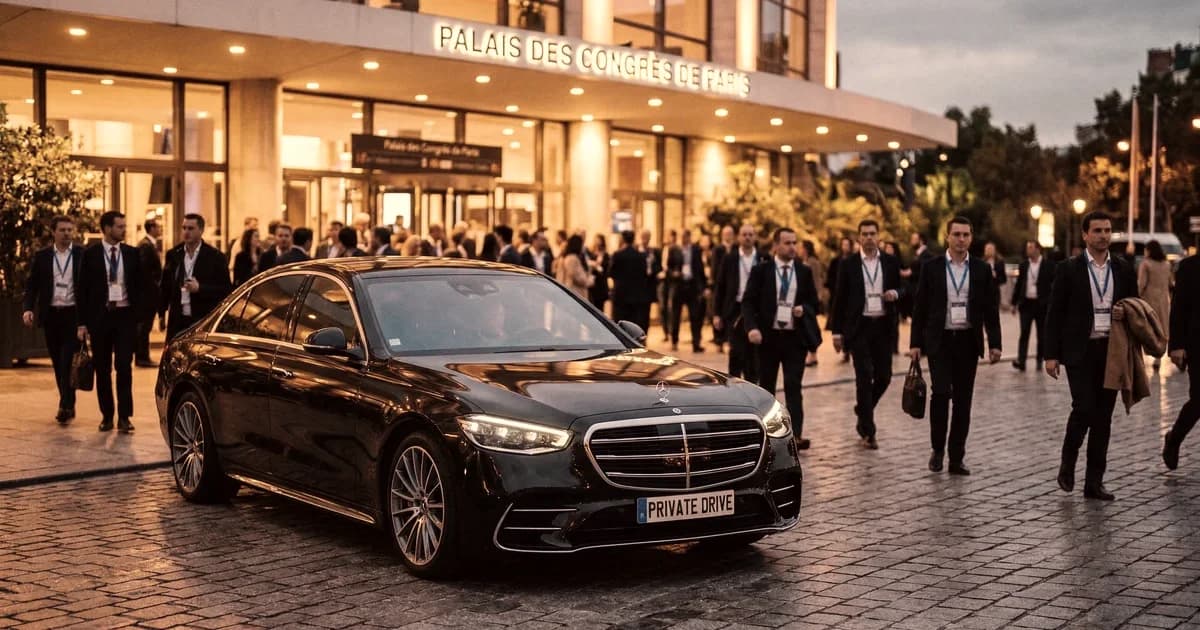
Palais des Congrès, Porte Maillot, the easiest venue in Paris
The Palais des Congrès sits at the western edge of the city next to the Périphérique, with up to 3,700 seats across its main auditorium and breakout rooms. It hosts medical congresses, financial summits, automotive product launches. Metro line 1 runs directly underneath, with a transfer to RER A at La Défense connecting the venue to CDG by public transport in around 50 minutes.
Public transit handles the delegate base. It does not handle keynote speakers, board members, or anyone arriving with materials. CDG to Porte Maillot is 38 km, 45 to 55 minutes off-peak. The road geometry is friendlier than for southern venues because the A1 feeds the Périphérique close to Maillot. For a congress with 100 plus delegates, the standard pattern is split: coaches for the synchronised arrivals on a single flight wave, sedans for named keynote speakers and C-suite participants who want to walk straight from arrivals into a vehicle. Setting up a framework agreement ahead of the event compresses the booking workflow to a single named coordinator.
Porte de Versailles in 2026, what the Pavilion 3 closure means
Paris Expo Porte de Versailles is France’s largest exhibition site, hosting Viva Technology, the Paris Auto Show, SIAL in alternating years and a long catalogue of international trade fairs. VivaTech 2026 runs from 17 to 20 June, the largest single MICE event in the city this year. The site has its own metro stop on line 12, plus tram T2 and T3a, but the walk from street level to a specific hall can stretch beyond ten minutes for a delegate carrying materials.
The 2026 change every planner needs to track: Pavilion 3 closed on 10 December 2025 and the construction phase began in mid-February 2026 for a 24-month rebuild, the third and final phase of a wider modernisation programme that covers 212,545 m² across seven pavilions and a 70,000 m² conference centre. Pavilions 2 and 3 are out of the rotation. Events that historically occupied that footprint have shifted to Pavilion 1, Pavilion 7 or Villepinte, with knock-on effects on entrance assignment, drop-off geometry and which side of the site is congested at any given hour.
Operational consequence: confirm your specific hall and entrance number before briefing drivers. Porte de Versailles has multiple numbered entrances and the construction perimeter has rerouted at least two drop-off lanes through Boulevard Victor and Place de la Porte de Versailles. A fleet of sedans deploying to the historical entrance number on opening morning means delegates walking 400 metres around scaffolding, with luggage, late.
Orly is the closer airport, 16 km, around 25 minutes outside peak. CDG is 55 km, 55 to 70 minutes in standard traffic. International North American or long-haul delegates almost always land at CDG and need that 55 minute window built into the morning schedule.
Paris Nord Villepinte, the CDG-adjacent venue
Villepinte is 7 km from CDG and 30 km from central Paris. It hosts Midest, SIAL on its alternating year, Euronaval and overflow for the Paris Air Show in years when the Le Bourget site reaches capacity. The 56th edition of the Air Show runs from 14 to 20 June 2027, biennial cycle confirmed. Proximity to CDG is the venue’s defining advantage. A delegate landing at Terminal 2E can theoretically reach their stand at Villepinte in 30 minutes including baggage claim.
RER B drops at Villepinte and works for the bulk of delegates. For C-suite attendees, exhibitors with equipment, and anyone running a same-day Paris-to-Villepinte-to-meeting-back-to-Paris loop, dedicated vehicles remove the friction. Minibus or coach from central Paris to Villepinte is 40 to 50 minutes off-peak, longer at the morning opening rush.
Carrousel du Louvre and the gala-venue logic
The Carrousel du Louvre is the most prestigious small to medium event space in Paris, located directly under the Louvre pyramid. It hosts luxury brand launches, exclusive corporate dinners, fashion presentations. Capacity caps the group size; nothing caps the expectations. The transfer here is short from any luxury hotel: 10 to 20 minutes from Triangle d’Or, Saint-Germain or the Marais.
Two operational details matter. First, guests arrive at either the Pyramide entrance or the Carrousel entrance depending on the event configuration; clarify with the venue and brief drivers. Second, prestige venues have controlled access points for coaches and minibuses; coaches typically park on adjacent roads such as Rue de Rivoli or Avenue du Général Lemonnier, with delegates walking the last 50 metres. Mercedes E-Class, S-Class or BMW 7 Series sedans are the standard vehicle level for evening Carrousel arrivals. The same logic applies at Musée d’Orsay, Grand Palais and Musée du Quai Branly.
Vehicle mix for a 200-delegate movement
The right vehicle mix depends on three variables: group size, service level expectation, and timing precision. A typical large-congress fleet looks like this.
Individual VIP transfers (1 to 3 passengers). Mercedes E-Class, S-Class or BMW 7 Series. Appropriate for keynote speakers, board members, sponsoring executives received as guests. The vehicle is part of the message.
Working delegations (4 to 7 passengers). Mercedes V-Class or equivalent premium minivan. The right answer for a management team travelling between hotel and venue together, or a speaker arriving with equipment. Executive seating, climate control, boot space for materials.
Delegate shuttles (8 to 16 passengers). Minibus. Best for moving homogeneous groups on a fixed schedule between hotel and venue. Can carry event or company livery for branded conferences.
Group movements (16 plus). Coach. The default for airport arrival waves, end-of-day hotel returns, gala dinner movements. Requires a logistics coordinator at the venue end.
For a 200-delegate congress with named VIPs, the standard deployment is hybrid: two to three coaches for the main delegate flow, six to ten sedans for VIPs and speakers, plus a dispatcher on-site throughout opening and closing days to handle real-time changes. The same logic that drives a multi-stop executive roadshow across Paris applies, scaled up to a 200-person operation.
Airport waves, the first 24 hours
International congresses mean international flights, which means a delegate arrival pattern spread across a 4 to 6 hour window with luggage delays and missed onward connections. The morning of day one is when transport coordination either delivers or fails publicly.
CDG to central Paris MICE hotels: from €150 per sedan. For a major congress, the standard PrivateDrive pattern is to deploy multiple vehicles in sequenced rotations, each tied to specific flight times. Delegates do not share vehicles with strangers; they receive a named confirmation with their driver’s mobile and a backup line.
Orly to central Paris: from €120 per sedan. European and domestic carriers favour Orly; North American and long-haul use CDG.
Le Bourget for private aviation: from €130 per sedan. For ultra-high-net-worth delegates and keynote speakers arriving by jet, Le Bourget is 12 km from central Paris with red-carpet protocol available. The detail set is documented in our Le Bourget executive transfer standards.
Eurostar arrivals at Gare du Nord: European delegates from London, Brussels and Amsterdam often arrive by train rather than fly. The Gare du Nord transfer guide covers the platform-to-vehicle protocol that matters when a 9 am session leaves no margin.
Group arrival protocol. For a conference expecting 200 delegates arriving from CDG over a 3-hour window, the optimal approach is six to eight vehicles in rotation, each completing two or three airport-to-hotel cycles, with a ground coordinator at the arrivals hall managing assignment in real time.
Gala dinners and evening logistics
The end-of-day movement from conference hotel to gala venue and back is the transport moment guests remember. They have spent the day in sessions. The dinner is the social peak. Arriving in a well-organised, comfortable vehicle puts them in the right frame of mind before the first canapé.
Three points hold up most evening operations. Departure timing: gala dinners at prestigious venues typically start 7:00 to 7:30 pm, and Paris evening traffic peaks 6:00 to 8:00 pm; build 30 extra minutes into the journey versus a midday equivalent. Return coordination: decide upfront whether vehicles return at a fixed time or sit on call for as-directed return. The latter is more guest-friendly but requires a clear driver briefing. Drop-off geometry: prestigious venues control coach access points, so pre-coordinate with venue operations on Rue de Rivoli, Quai Anatole France or Champ de Mars depending on the venue.
The dispatcher question
For events over 50 delegates, remote coordination breaks under load. The first hour of arrival traffic generates more real-time exceptions than a remote operator can handle by phone: delayed flights, early arrivals, last-minute additions, drivers who need to be redirected because a delegate is at Terminal 2F not 2E. A dedicated PrivateDrive dispatcher, on site or on a dedicated WhatsApp line, manages the flow. This is not an optional luxury for large events. Its absence is what turns a smooth arrival into a recovery exercise the planner spends the rest of the conference apologising for.
The same logic that drives an executive board meeting transfer from CDG applies at MICE scale, with a multiplier effect. A single missed VIP becomes a single embarrassing photo. A coordinated 200-delegate arrival on a tight schedule becomes the reason the same client books PrivateDrive for the next year’s congress.
What separates a transport vendor from a transport partner
The difference between adequate and exceptional MICE transport is rarely dramatic in any single instance. It accumulates. The delegate who felt met and managed rather than left to navigate. The keynote speaker who arrived calm rather than flustered. The gala return that felt like a conclusion, not a scramble. Three or four of those experiences across a four-day congress determine whether delegates leave saying the event was world class, or just well organised. Paris is recovering its ICCA position partly because organisers are choosing partners who treat ground transport as part of the experience, not the line item the budget tries to cut last.
Booking a 200-delegate congress in 2026 means working four to six weeks ahead, agreeing the vehicle mix, locking the rate structure, briefing drivers on the venue geometry, and naming the on-site dispatcher before the first delegate lands. For peak congress weeks (September, October, March, June), earlier is mandatory because vehicle availability tightens. PrivateDrive’s corporate desk handles fleet allocation, framework agreements and event coordination for conferences from 10 delegates to 2,000.