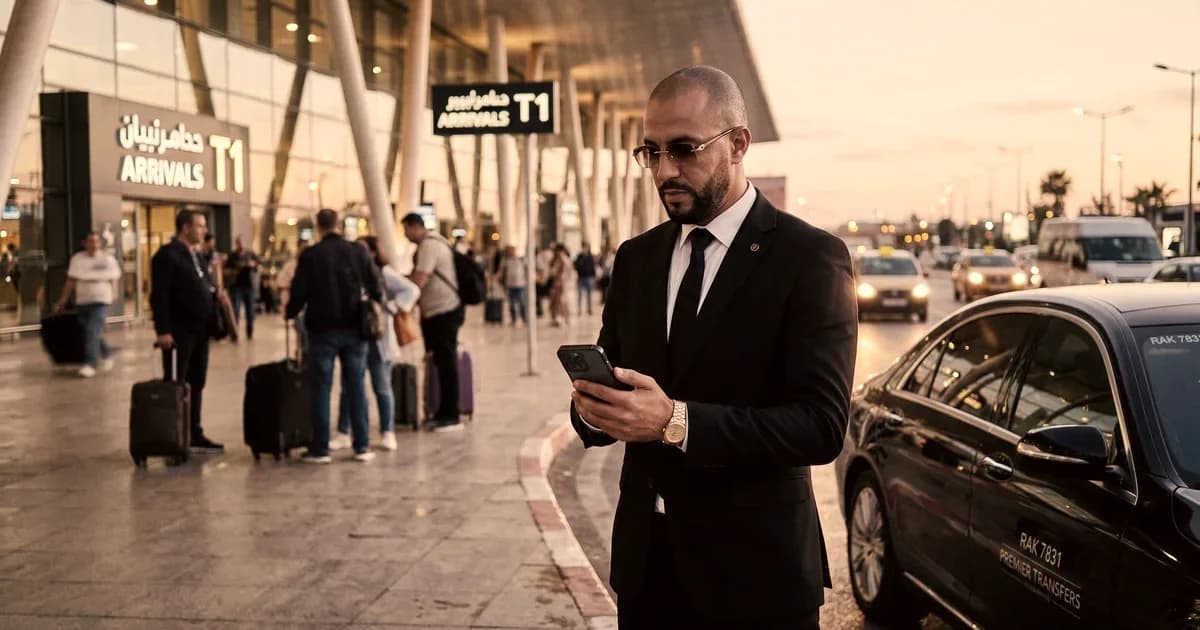
The flight from London City touches down at CDG at 08:05. The board meeting is at 09:30 in a tower at La Défense. Eighty-five minutes to cover the arrival, passport control, baggage, ground transport, and the building reception. This is not a scenario drawn from a planning template. It is a case that corporate travellers and executive assistants coordinate dozens of times a year at PrivateDrive, and 2026 has changed what the math looks like.
The guide below covers three things: the data, the protocols that actually work, and the post-EES reality that made the older playbooks unreliable. The objective is a transfer that behaves predictably on the single day it needs to, not an averaged fantasy.
The 60-minute benchmark, reread after April 2026
Short answer: the 60-minute airport-to-boardroom is achievable under specific conditions, and the conditions are narrower than they were a year ago. The EU Entry/Exit System rollout in April 2026 reshaped passport control at CDG. Industry reporting has documented queues of up to two hours at Terminal 2E during the afternoon arrival bank, with biometric kiosks processing roughly 35% fewer travellers per hour than originally forecast. Several multinationals have issued new travel guidance that avoids booking meetings earlier than 12:00 the day after a transatlantic arrival.
Against that backdrop, the five conditions that still make a 60-minute window realistic are:
- Passport control under 15 minutes, which in 2026 means an EU passport processed at a PARAFE eGate. Non-EU passports under EES are still cleared manually at most CDG terminals, with processing times that no transfer schedule can absorb on a morning peak.
- No checked luggage. Baggage claim adds a minimum of 20 minutes, and the variance is uncontrollable.
- A driver positioned landside before you clear customs. Your chauffeur is holding a name board in the arrivals hall, not dispatched when the flight lands.
- Off-peak road window. CDG to La Défense in under 35 minutes is only realistic before 07:30 or after 09:30, because the A1 southbound and the Pont de Neuilly both clog between 07:45 and 09:15.
- A boardroom in the arrivals zone of the building. A 32nd-floor suite with visitor badge procedures and a 4-minute lift cycle compounds the final segment.
When all five align, the 60-minute CDG-to-boardroom exists. For a typical Monday scenario with a non-EU passport, checked luggage and peak-hour roads, the realistic floor has moved from 90 to 110 minutes in 2025 to 110 to 140 minutes since the EES rollout. The professional response is not to fight that shift. It is to build a schedule that bakes the new buffer in and to eliminate the variables that remain under control.
Variables still in your hands: a pre-trip protocol
1. Carry-on discipline
C-suite travel tolerates one variable badly, and it is checked luggage. A strict carry-on rule takes the largest unpredictable delay off the board. A garment bag fits in most business-class overhead bins. If the stay requires more, a courier service or the Paris hotel can handle a second bag dispatched in advance.
2. The right flight, not just the convenient one
Not every morning arrival at CDG behaves the same way for ground transfer purposes. The optimal profile:
- Arrival before 07:00, which places both passport control and the A1 southbound before their morning peaks.
- Terminal 2B or 2C, which remain smaller and faster than 2E and have not absorbed the same EES overhead.
- Business class, where the cabin deplanes first and where several terminals operate a separate passport control lane.
For the London corridor, the case for Eurostar keeps strengthening. A Gare du Nord arrival removes CDG and its passport-control variance from the equation. Gare du Nord to La Défense by private car takes 30 to 45 minutes under 2026 traffic, against 55 to 70 minutes from CDG before you even account for EES. The Eurostar transfer playbook covers the protocol in detail.
3. PARAFE, for the passports that still qualify
EU nationals, and the third-country travellers whose passports the gate accepts, clear biometric eGates at CDG in under five minutes, against 25 to 40 at a staffed booth in 2025 and longer since. For executives who come to Paris more than twice a year on a compatible passport, PARAFE registration remains a worthwhile investment. For US, UK and other third-country passport holders now subject to EES, PARAFE does not currently substitute for the manual lane; the planning buffer has to be built elsewhere.
4. Pre-position the driver
A professional chauffeur does not leave for CDG at the moment your flight is due to land. The PrivateDrive protocol computes departure from the flight's expected gate arrival, adjusted live for A1 conditions. The driver is landside, inside the arrivals hall, holding your name board before you clear customs. No phone call, no bag-drop taxi queue.
CDG to Paris business districts: 2026 time data
The figures below reflect Monday to Friday morning peak (07:30 to 09:30) under current 2026 road conditions. The passport-control segment is tracked separately because it now concentrates the largest variance.
| Route | Off-peak road | Morning peak road |
|---|---|---|
| CDG to La Défense (Grande Arche, Tour Total) | 33 to 38 min | 55 to 75 min |
| CDG to 8th arr. (Champs-Élysées, Avenue George V) | 38 to 45 min | 60 to 80 min |
| CDG to 9th arr. (Opéra, Grands Boulevards) | 40 to 48 min | 65 to 85 min |
| CDG to 16th arr. (Trocadéro, Passy) | 42 to 50 min | 65 to 80 min |
| CDG to Boulogne-Billancourt | 45 to 55 min | 70 to 90 min |
| CDG to Orly (inter-airport) | 45 to 50 min | 55 to 70 min |
For La Défense specifically, the Pont de Neuilly approach and the A14 tunnel are the two congestion points that separate a professional chauffeur from a GPS-following service. The Avenue du Verdun alternative and the Pont de Puteaux entry save 10 to 15 minutes in peak, and they are a local routing reflex rather than an app suggestion. Our 2026 pricing guide tracks the fixed CDG rate at €150 for a standard sedan, with executive S-Class and V-Class bands on top.
What the driver actually does on a board day
A board meeting transfer is not a task for an on-demand rideshare. The services that matter, and that no app replicates:
Pre-trip intelligence. The driver reviews A1, A3 and Périphérique conditions from 06:00 on the morning of the transfer. Known incidents get priced into departure timing. If conditions shift, the booker is briefed directly, not left to read a traffic feed.
Flight monitoring. Real-time inbound tracking. If ATC holds delay the flight by 20 minutes, the driver absorbs the change; the passenger takes no action.
Name board at arrivals, landside. The executive exits passport control and sees their name. No searching, no calling, no standing in a 35-minute taxi rank.
Vehicle briefed in advance. Meeting context, client name, exact tower entrance and floor, the nature of the brief. The driver knows the destination before the passenger steps into the car.
Silent professionalism on the drive. The 35 to 70 minutes from CDG to La Défense are time an executive may use to review a deck, take a call, or decompress from the flight. The driver does not initiate conversation, does not set the radio, and does not comment on traffic. This is covered in the executive assistant protocol.
Arrival handoff. Five minutes before reaching the building, the driver confirms the entrance. For La Défense towers, the guest entrance, the service entrance, and the parking garage access are three different decisions with three different pickup patterns at the end of the day.
Multi-executive coordination for a board day or roadshow
Three executives landing on three different flights, all bound for the same boardroom inside a 30-minute window: the logistics compound. PrivateDrive runs these as a coordinated event rather than as stacked independent bookings.
- A dedicated fleet coordinator assigned from 48 hours before the event.
- A single point of contact for the executive assistant managing the day.
- A real-time tracking dashboard showing all vehicle positions and ETAs.
- Vehicles sized to each passenger load, from solo sedans to V-Class executive vans for groups of 3 to 4.
- Contingency authority for the coordinator: if one vehicle is delayed, the dispatcher can redeploy or reroute without waiting for client instruction.
Paris roadshows, where four to six meeting venues across the city have to be hit in a single day, use as-directed chauffeur service. The driver stays with the principal all day, managing the schedule in real time. The roadshow protocol walks through the sequencing.
The pricing reality at board level
Corporate transport at this level is priced on value, not on mileage. 2026 benchmarks for Paris:
| Service | Typical cost |
|---|---|
| CDG to La Défense, executive sedan | Fixed price, shown before booking |
| CDG to central Paris, S-Class | €230, fixed |
| Full-day as-directed chauffeur | €85/h, minimum 3 hours |
| Multi-vehicle roadshow coordination, per day | From €680 per vehicle (8 hours), quoted to the programme |
| Emergency same-day (3 hours notice or less) | Standard rate plus 20% |
For a board day where the principal's billing rate sits between €5 000 and €15 000, ground transport is a rounding error on the ledger. What matters is certainty. The executive walks into the right building, at the right time, composed and briefed, rather than recovering from a 45-minute taxi queue at CDG and a phone-call reroute to the right tower entrance. The calculation that the CFO case documents is the same logic read off the P&L side.
Where the smart board day actually wins or loses
The 60 minutes from the gate to the lift are decided before the flight takes off. Carry-on discipline, a Terminal 2B or 2C arrival instead of 2E, a compatible passport with PARAFE registered, a chauffeur pre-positioned landside, and a pre-briefed vehicle on a route that skips the Pont de Neuilly approach: each of those decisions narrows the distribution of outcomes by ten to twenty minutes. Stack them, and the airport-to-boardroom sequence behaves. Break one, and the same day becomes a taxi queue and an apology.
The 2026 shift worth naming is that the variance that kills this calculation now sits mostly at passport control, not in traffic. The highest-ROI move for travel managers this quarter is to rebuild the buffer model around EES, then look at whether Eurostar for London routes, Le Bourget for transatlantic private aviation, or a pre-night hotel arrival for critical board mornings should take a larger share of the travel policy. Those three decisions make the ground-transport layer predictable; they do not require abandoning commercial aviation on every trip. PrivateDrive coordinates the sequencing so that the door handle is the only thing the executive has to touch.