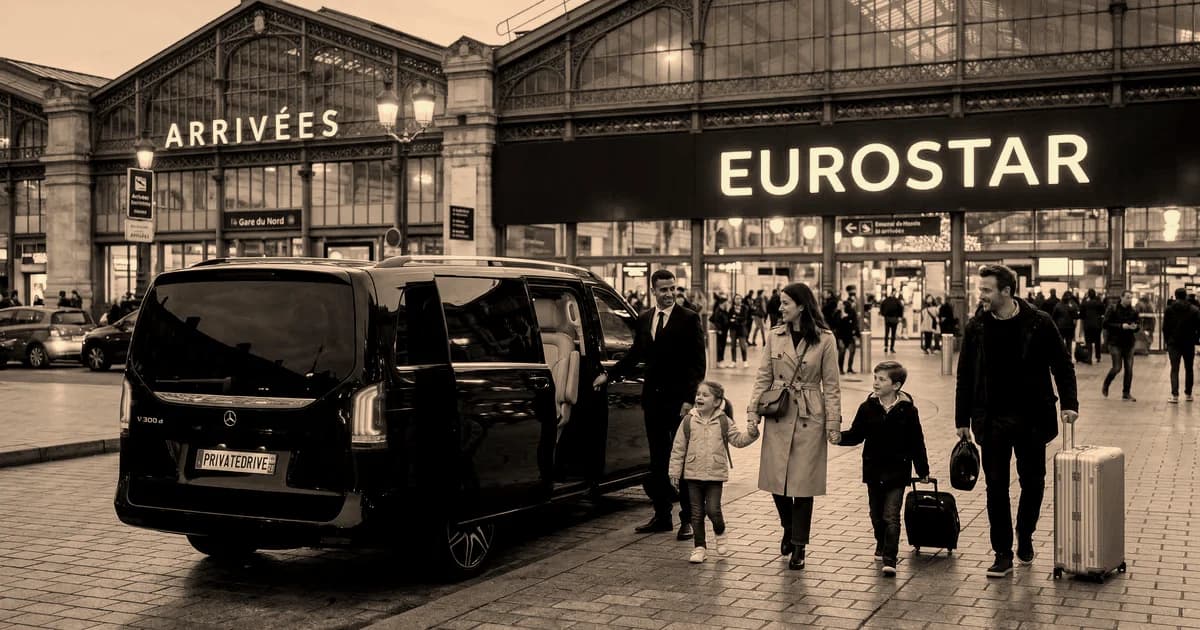
The Eurostar departure board at St Pancras International reads 08:01. Your driver dropped you on Pancras Road at 07:18. By 07:34 the Eurostar Premier passport check is behind you and the lounge espresso is in your hand. By 10:17 Paris Gare du Nord, two hours and sixteen minutes after London. By 11:05, if the Paris end is set up correctly, you walk into the lobby of the George V or step out of the lift on the executive floor at La Défense.
That is the cross-Channel journey when both terminals work. The 2h16 train is the easy part. Everything that holds or breaks the schedule sits at the two ends, in the transfer to St Pancras and the transfer from Gare du Nord.
Why Eurostar Holds Up Against the Air Route in 2026
City centre to city centre, Eurostar wins on time and on consistency. A typical London-to-Paris flight via Heathrow Terminal 5 builds out as follows: 90 minutes for check-in and security, 75 minutes in the air, 45 minutes for baggage and arrivals at Charles de Gaulle, then 50 minutes from CDG to a central hotel. That is 4 hours 20 minutes total. The Eurostar equivalent with two correctly arranged transfers is closer to 3 hours 50 minutes. The advantage is real but conditional. A slow taxi at either end erases it.
Two operational shifts in 2026 have widened that advantage further. CDG arrival times are now exposed to the EU Entry/Exit System (EES), which began phased rollout on 12 October 2025. Air travellers from outside the Schengen area increasingly experience longer immigration processing on arrival. Eurostar passengers, whose UK and non-EU passports are checked at St Pancras before boarding under juxtaposed controls, walk off the train at Gare du Nord without a passport queue. The second shift sits in the Eurostar product itself: the rebrand from "Business Premier" to "Eurostar Premier" took effect through 2024-2025, with refreshed lounges and a single Premier class across the network.
The London Side: From a Hotel to St Pancras Without Friction
St Pancras International has the best-organised forecourt of any major European rail terminus. The Eurostar entrance sits on Pancras Road on the north side of the building. A private chauffeur drops you at the kerb. Drivers cannot loiter: stops are limited to a couple of minutes, which is enough to offload luggage and walk to the international terminal entrance.
Approximate transfer times to St Pancras during 2026 traffic conditions look like this.
| Origin | Off-peak | Moderate | Peak |
|---|---|---|---|
| Mayfair, Park Lane | 22 min | 32 min | 52 min |
| Knightsbridge, Belgravia | 28 min | 40 min | 60 min |
| The City, EC2 | 18 min | 26 min | 45 min |
| Canary Wharf | 30 min | 40 min | 62 min |
| Heathrow Terminal 5 | 48 min | 62 min | 92 min |
The Eurostar check-in window targets 45 minutes before departure for Premier (with Premier lounge access) and 35 minutes before departure for Standard. Heavy luggage or a group adds 10 to 15 minutes. For an 08:01 train, leaving Mayfair later than 06:35 in normal traffic introduces unrecoverable risk. In peak conditions, leave by 06:00 and use the lounge.
St Pancras Check-In, Lounges and the EES Question
French border control happens at St Pancras before you board the train, not on arrival in Paris. UK and non-EU passport holders go through Police aux Frontières controls inside the international terminal. This is the Eurostar advantage: the immigration queue is in London, before security, on a process that runs at metro pace rather than airport pace. Typical clearance takes 15 to 25 minutes off-peak; busier morning windows can stretch beyond 30.
The EES went live across most Schengen entry points from October 2025 with a phased implementation. France missed the original April 2026 deadline for biometric capture at Channel crossings: the Police aux Frontières confirmed in early April 2026 that biometric registration under EES would not begin at Eurostar terminals on the planned date. The current state at St Pancras as of spring 2026: passport stamping continues as before, and the EES kiosks at Eurostar gates remain in test rather than live operation. This is good news for travellers in 2026 and a deferred risk worth tracking. When biometric capture goes live, first-time registrations are expected to add several minutes per passenger, with knock-on queue effects at peak departures. Build a 15 minute additional buffer into your London-side schedule from the moment activation is announced.
Eurostar Premier passengers (formerly Business Premier) access the dedicated Premier lounge at St Pancras: priority check-in, faster security, and a refreshed lounge interior delivered in 2025. Standard Plus and Standard travellers do not have lounge access and should plan around the public seating areas. Pricing for the Paris end of the journey remains stable for 2026 with airport flat rates set by the Préfecture de Police; the rail end is metered, which is one of the reasons booked transfers from Gare du Nord matter operationally.
The 2h16 in the Tunnel: What Actually Travels With You
The journey itself is short, quiet and consistent. Eurostar runs at up to 320 km/h on the high-speed sections (LGV Nord on the French side, HS1 on the British). Connectivity is improving, with onboard Wi-Fi reliable on the British half and patchy in tunnel sections. For executives who treat the train as productive time, Premier class delivers the working environment air travel cannot: a wide seat, table service, no seatbelt sign cycle, and the noise floor that lets a phone call land cleanly. For families and leisure travellers, the same setup absorbs three or four hours of children, luggage and food without the airport contact points.
The 2h16 is also the reason private transfers at both ends matter so much. When the train ride is shorter than the airport drive on the other side of the Channel, every minute of friction on the ground takes a disproportionate bite out of the door-to-door advantage.
Gare du Nord Arrivals: The First 15 Minutes Decide the Day
Gare du Nord handles roughly 700,000 passengers a day across SNCF main lines, Eurostar (which now also operates the former Thalys network to Brussels and Amsterdam), RER and metro. The Eurostar arrives on dedicated platforms at the north end of the building. UK and non-EU passport stamping happens at St Pancras before boarding; you walk off the train into the main concourse without an immigration queue.
Outside the building is where the Paris arrival either holds or breaks. The taxi rank on Rue de Dunkerque can stretch to 30 to 45 minutes during peak afternoon arrivals. Ride-hailing pickup zones are signposted but the surrounding street pattern often defeats the apps: drivers cannot find passengers, surge pricing kicks in, and English communication is not guaranteed.
A pre-booked private transfer from Gare du Nord follows a precise meeting protocol. The PrivateDrive driver tracks the Eurostar train number in real time. As the train pulls in, the client receives a WhatsApp message with the driver position: typically on Rue de Dunkerque opposite the main facade, with the vehicle make, plate and a landmark to walk toward. For Premier passengers and groups carrying significant luggage, the driver meets at the platform exit inside the terminal building and walks the client to the vehicle. Fixed-price arrival transfers from Gare du Nord to central Paris start at €130 in an E-Class, and the platform-to-vehicle protocol is detailed in the Gare du Nord transfer guide.
Approximate Gare du Nord journey times to common destinations.
- 1er and 4e arrondissements (Marais, Louvre, Opéra): 12 to 20 minutes
- 8e (Champs-Élysées, George V, Bristol): 15 to 25 minutes
- 7e (Eiffel Tower, Lutetia, Le Bristol): 25 to 40 minutes
- 16e (Peninsula, Shangri-La): 25 to 40 minutes
- La Défense and the corporate towers: 30 to 45 minutes
- CDG, for an onward flight: 35 to 50 minutes
The Reverse Leg: A Paris Hotel to St Pancras
Departing Paris on Eurostar requires arriving at Gare du Nord 60 to 75 minutes before the train. Both French exit controls and UK Border Force juxtaposed checks happen at the station, typically at the south end of the terminal upstairs. Premier check-in is faster, but lounge access is the reason to arrive earlier rather than later.
Recommended hotel pickup leads, calculated against typical Paris evening peak (17:00 to 19:30) and weekday morning peak (07:30 to 09:30), look as follows.
| Hotel zone | Pickup before Eurostar departure |
|---|---|
| 1er (Ritz, Meurice, Costes) | 60 minutes |
| 4e (Pavillon de la Reine, Marais) | 55 minutes |
| 6e (Lutetia, Saint-Germain) | 65 minutes |
| 7e (Le Bristol annex, Eiffel Tower area) | 70 minutes |
| 8e (George V, Bristol, Plaza Athénée) | 70 minutes |
| 16e (Peninsula, Shangri-La) | 80 minutes |
| La Défense | 75 minutes |
Add 15 to 20 minutes during peak periods. For executive transfers tied to a same-day inbound from CDG and an outbound on Eurostar, build the rotation against the train, not the meeting end time. The train is the fixed point.
Heathrow to Eurostar: The Tightest Connection in the Network
Travellers flying into Heathrow and continuing to Paris by Eurostar face the busiest transfer in the cross-Channel chain. The Elizabeth Line plus tube reaches St Pancras from Terminal 5 in 50 to 60 minutes with luggage. A private car along the A4/M4 corridor and through central London runs 45 to 70 minutes depending on traffic. Eurostar check-in adds 35 minutes minimum. The arithmetic produces these targets.
- Heathrow T5 to St Pancras by private car (off-peak): 48 minutes
- Minimum Eurostar check-in for Standard: 35 minutes
- Minimum total connection at the London end: 95 minutes
- Recommended buffer for a stress-free connection: 2 hours 15 minutes
For a 06:00 Heathrow arrival on a transatlantic flight, the first comfortably catchable Eurostar departure is the 09:01 or 10:01. Earlier is theoretically possible and operationally fragile. PrivateDrive coordinates the Heathrow pickup and the Paris-side arrival on a single booking reference, so a delayed flight on the London side automatically reschedules the Paris driver. Splitting the booking across two operators removes that coordination layer and reintroduces the failure mode the train was meant to eliminate.
The Disruption Year: 2025-2026 Service Reality
The Channel Tunnel had a major power outage in late December 2025 that stranded passengers overnight. Belgian rail strikes in March 2026 reshaped Eurostar timetables on the Brussels and Amsterdam routes for several weeks. Industrial action and signalling incidents have produced a more variable Eurostar service through the first half of 2026 than in the prior decade. The probability of a delayed train on any given booking remains low, but it is no longer the rounding error it was.
The operational answer is not to avoid Eurostar. The operational answer is to build the ground transport against the train as a tracked event rather than a fixed time. Drivers who watch the train number in real time, dispatch teams who reroute when a delay is announced before the passenger sees it, and a Paris-side meeting protocol that triggers on platform arrival rather than on schedule. That is the difference between a partner and a vendor.
Vehicle Choice for Each End
For a single executive or couple travelling Premier, a Mercedes E-Class or S-Class on both ends is the standard. Boot space takes two suitcases; cabin bags ride inside. The vehicle is silent enough for a phone call. Driver presentation matches the level of the journey.
For a working delegation of three to six, a Mercedes V-Class is the right tool: executive seating, a centre table, climate zoning, and luggage capacity for a full board team. The same vehicle handles the Heathrow-to-St Pancras pickup and the Paris-side arrival, so the team experiences continuity.
For larger groups (8 to 16 people moving together for a roadshow or product launch), a minibus on both ends keeps the group in one vehicle. Splitting across two cars on a corporate movement adds coordination friction without saving real money once two driver fees are factored in. A corporate framework agreement handles the rate structure, the named coordinator, and the cross-Channel routing, so an executive assistant does not need to negotiate two operator relationships per trip.
Building a Cross-Channel Booking That Holds
The mistake most first-time Eurostar bookers make is treating the train as the journey and the transfers as add-ons. The reverse perspective is more accurate: the train is the easy 2h16 between two harder operational moments, and the booking design should start from those moments outward.
A working booking template covers four points. First, the Paris driver receives the Eurostar booking reference at booking and tracks the train independently of any communication from the client. Second, the London driver receives the Eurostar booking reference and is briefed on the Premier check-in window for that specific train. Third, the contact line between client, London driver and Paris driver runs through a single dispatcher who can reroute either end without the client managing it. Fourth, every fixed price is locked at booking, so a delay does not become a billing conversation.
The 2h16 in the tunnel sells itself. The 30 minutes either side is the work.
Cross-Channel, Without the Friction
The Eurostar route is one of the fastest, most civilised journeys in Europe. It deserves to feel that way from the hotel kerb in London to the lobby in Paris. Two correctly arranged private transfers, one at each end, on a single booking reference, with drivers who track the train: that is the entire formula. Everything else (the check-in window, the lounge, the seat) is already in the price of the ticket. The transfer is the variable.
Book your Paris arrival or departure transfer with PrivateDrive: provide the Eurostar arrival or departure time, the Gare du Nord meeting preference, and your destination address. The driver will be in position when you step off the platform, or at the door when the schedule says you leave the hotel.