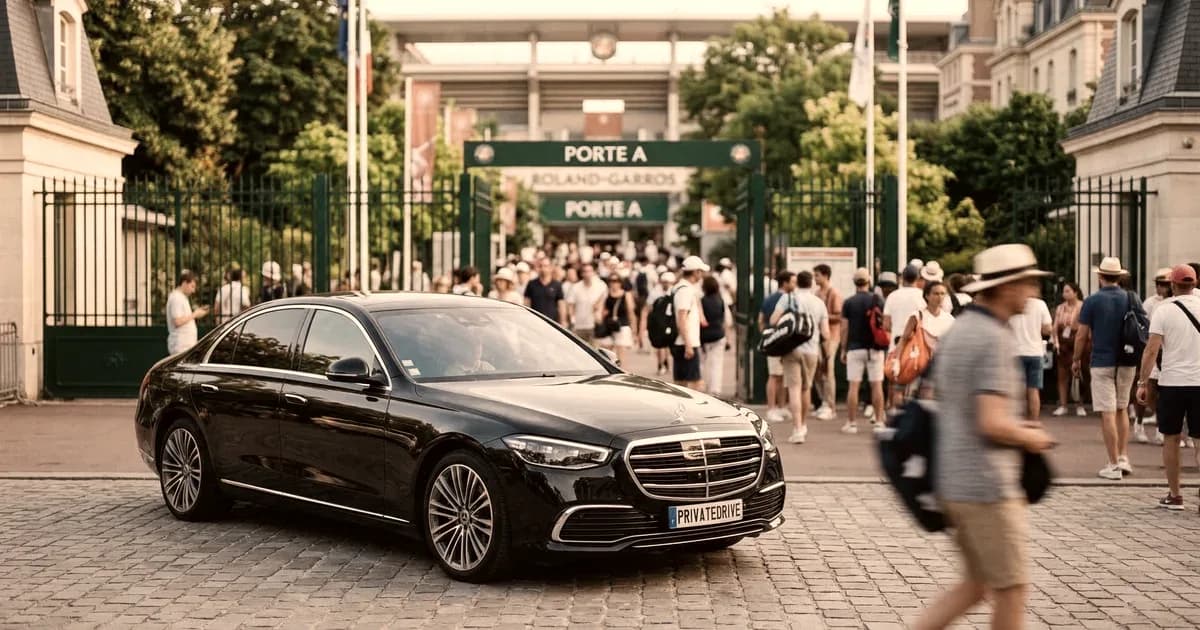
Every year from mid-May to early June, the 16th arrondissement rewires itself around a single postcode. The Stade Roland Garros, the only Grand Slam still played on clay, pulls more than 500 000 spectators over three weeks and tightens a security perimeter that makes every vehicle in the neighbourhood move differently. In 2026 the dates are set: opening week May 18 to 22, main draw May 24 to June 7, women’s final on Saturday June 6, men’s final on Sunday June 7.
Arriving by chauffeur is the quickest way to the gates, provided the logistics are understood before the booking. The stadium itself is off-limits to cars on tournament days. Every ticket holder, no exception, crosses one of three external checkpoints and walks the last few minutes in.
Why a direct drop-off is not on the table
Roland Garros sits at 2 Avenue Gordon Bennett, 75016 Paris, backed against the Bois de Boulogne. Geographically the stadium is reachable. Operationally, during the tournament, it is not. The Fédération Française de Tennis routes all arrivals through three Points de Passage Obligatoire, or PPOs, placed well outside the stadium walls.
- PPO Auteuil, Place de la Porte d’Auteuil, 75016. The main arrivals checkpoint.
- PPO Molitor, 2 Avenue de la Porte Molitor, 75016. Preferred for match-end departures to avoid the Auteuil bottleneck.
- PPO Boulogne, Route de Boulogne à Passy, 75016, with a secondary access at Carrefour des Anciens Combattants.
Chauffeurs drop off and pick up at one of the three PPOs. They do not approach the stadium gates. Confirming which PPO you will use before you enter the venue is the single most useful piece of preparation; it removes twenty minutes of confusion at match end, when ten thousand people are walking in the same direction.
Transfer times from every realistic origin
The numbers below assume a Mercedes sedan or V-Class with a professional chauffeur, 2026 road conditions, and zero strike activity. They are split by off-peak and peak windows because the Périphérique western arc behaves very differently at 09:00 and at 18:30.
From Charles de Gaulle (CDG)
Off-peak (before 07:30, or after 20:00): 45 to 55 minutes from Terminal 2E to PPO Auteuil. Typical route is the A1 south to Porte de la Chapelle, then the Périphérique west to the Porte d’Auteuil exit. Peak traffic (08:00 to 10:00 or 17:00 to 20:00) stretches the same route to 75 to 100 minutes, sometimes more on a Grand Slam Friday. For a 10:00 gates-open session, a CDG pickup earlier than 08:00 is the only sensible window if you are coming the morning of the match. A smarter structure is to transfer to a Paris hotel the night before and use an in-city transfer on match day. This is how the professional circuit itself handles logistics, and the cost delta against an airport-day rushed booking is usually negligible. Our 2026 pricing guide tracks the fixed CDG rate at €150 for a standard sedan.
From Orly
Off-peak: 35 to 45 minutes from Orly Terminal 3 to PPO Auteuil via the A6 north and the Périphérique west. Peak: 55 to 75 minutes. Orly is the closer airport for the 16th arrondissement, which is a small but real advantage if your arrival window is early afternoon and the tournament is running a day session. Passengers routing via Orly’s south-west terminal should allow an extra ten minutes for the terminal-to-roadway walk before the car clears Orly.
From Le Bourget
Off-peak: 40 to 55 minutes from the Le Bourget FBO complex to PPO Auteuil, via the A1 south and the Périphérique west. Private-aviation passengers gain time at the arrival end, where the gate-to-vehicle transition runs five minutes rather than thirty. Full protocol is documented in our Le Bourget standards piece.
From Paris hotels
| Hotel zone | Off-peak transfer | Note |
|---|---|---|
| 16th arrondissement | 5 to 15 minutes | Some Trocadéro addresses are a 20-minute walk to PPO Auteuil |
| 7th (Eiffel Tower area) | 10 to 20 minutes | Closest non-16th hotel zone |
| 8th (Champs-Élysées) | 15 to 25 minutes | Direct via Avenue Foch |
| 1st / 2nd (Louvre, Opéra) | 25 to 35 minutes | |
| Marais (3rd / 4th) | 30 to 40 minutes | Add a buffer on Friday afternoons |
The 2026 calendar, and the days that change the math
Opening week runs Monday May 18 to Friday May 22 with qualifying rounds and practice sessions. During opening week, gates open at 09:00. From Sunday May 24 onwards, gates shift to 10:00 and the main draw begins. Night sessions on Court Philippe-Chatrier start at 20:15 and, under the retractable roof, can finish well past midnight; the tournament runs night sessions every day through the quarter finals. Women’s final is Saturday June 6, men’s final Sunday June 7.
Three dates are worth flagging because they compress every transfer window in the city at once. The final weekend is the obvious one, with both finals and the closing ceremonies drawing VIP traffic into the 16th. May 30 and May 31, the middle Saturday and Sunday, are historically the highest-volume sessions by spectator count. Any major football fixture at the nearby Parc des Princes, especially in the last Champions League weeks, creates compounding congestion on the Périphérique west around match time. Michel-Ange Molitor metro closes at 22:00 during tournament nights, which matters if you had planned to mix a chauffeur arrival with a metro return.
Drop-off choreography at the three PPOs
Each PPO has a specific pickup geometry that is worth locking in before the morning of the match.
PPO Auteuil is the intuitive arrival point from central Paris and CDG. Drop-off happens in front of the fountain on Place de la Porte d’Auteuil. Walk to the stadium gates runs one to two minutes. This is the busiest PPO and the one where post-match taxi queues are longest, which is why most regulars arrive here but depart elsewhere.
PPO Molitor, at 2 Avenue de la Porte Molitor, is the pragmatic departure point. Walk to the southern stadium exits is five to nine minutes, and the road layout lets a chauffeur reposition without circling the block three times. If you have a Mercedes V-Class waiting with luggage, this is the point you want.
PPO Boulogne, on Route de Boulogne à Passy, is the quieter alternative and worth using for disabled mobility or when your hotel sits to the south of the 16th. Less foot traffic, less taxi competition, longer walk back to most seating blocks.
Note on official taxi stands. The FFT sets up temporary taxi ranks during the tournament at Place de la Porte d’Auteuil, Porte Molitor and Allée de la Reine Marguerite. These are a reasonable fallback if a pre-booked chauffeur has not been arranged, though queues after a completed match (especially a rain-delayed Chatrier evening) can run forty-five minutes or more.
How chauffeur services handle return pickups
The outbound leg is easy. The return leg is where planning pays. Roland Garros matches do not finish on a fixed schedule. A men’s Chatrier session that opens at 14:00 can end at 18:00, at 19:30, or at 21:15. The chauffeur protocol that actually works runs as follows.
Before you enter the venue, confirm the PPO you will exit from, the phone number of the chauffeur, and a WhatsApp channel for match-end updates. The driver holds a waiting position within five minutes of the PPO throughout the match, typically at a nearby paid car park or a legal standing zone. When the final set begins, you message the driver. When your block exits, you message again. The vehicle rolls up to the PPO as you reach it, not before and not after.
Night sessions require a different posture. A 20:15 Chatrier match can end at 01:30 in a five-setter. The chauffeur needs confirmation that the booking covers post-midnight coverage, because not every service offers it as default. PrivateDrive does, and the cost structure reflects it transparently rather than via post-ride surprise.
For passengers flying in the morning of a day session, the workable arrangement is a single booking from CDG or Orly to the PPO, with luggage either taken straight to the hotel by a second vehicle or stored in the V-Class during the match. A second-vehicle handoff costs more but removes the stressful luggage variable for clients arriving on a short window. Similar multi-leg protocols are discussed in our executive roadshow guide.
The booking window that closes earlier than it should
Roland Garros tightens chauffeur supply in Paris more than any other single tournament, more than Fashion Week, more than VivaTech, and in some years more than the final days of the Salon de l’Agriculture. Two structural reasons drive this. First, the tournament runs twenty-one consecutive days, which is roughly three times the footprint of a typical Parisian marquee event. Second, the overlap with Monaco GP the week before and with early-summer corporate season means a significant share of the premium Paris fleet is already committed to hotel accounts, roadshows and diplomatic transport before the Roland Garros draw is published.
The operational consequence is that booking four weeks out is not a luxury, it is the minimum horizon at which a serious chauffeur service can guarantee a vehicle and driver for a specific slot. Two weeks out, the selection narrows. Under a week, most premium operators in Paris will route new requests to waitlist only, and rate parity across the market breaks down. If you have confirmed tickets for any session after May 28, the question is not whether to pre-book the ground transport. It is which sessions to lock the chauffeur for and whether to hold an option on the final weekend in case the draw pushes a match you want to attend into a different slot.
Fix the day-session transfers first, because those have the hardest timing constraints. Night sessions can be booked slightly later because more drivers are available past 20:00 in May once other corporate clients have completed their return transfers. Hotels can help, but the palace concierge supply chain for chauffeur bookings saturates before the general market does.
Travellers combining Roland Garros with a broader Paris stay often build a structured three-day itinerary around the sessions, which allows the chauffeur to cover airport arrival, the PPO transfer, evening dining or cultural stops, and the return leg under one consolidated booking.
What the smart tennis traveller does differently
Three decisions separate a stressful Roland Garros day from a smooth one. Arrival geometry, which means knowing which PPO you enter through and why. Return choreography, which means locking a post-match pickup point with a driver who is actually close by rather than crossing Paris to collect you. And booking horizon, which means treating four weeks out as the real deadline and not the nominal one.
Once those three decisions are made, the rest of the day compresses into what it should be. A car to the gate, a clear walk in, a match, and a quiet ride back. The tournament is the reason you are in Paris, not the transport logistics around it. PrivateDrive runs Roland Garros bookings as a dedicated window through the tournament period, with drivers familiar with the PPO patterns and with 24/7 availability for the post-midnight Chatrier sessions. The earlier the booking, the wider the vehicle choice and the cleaner the scheduling.