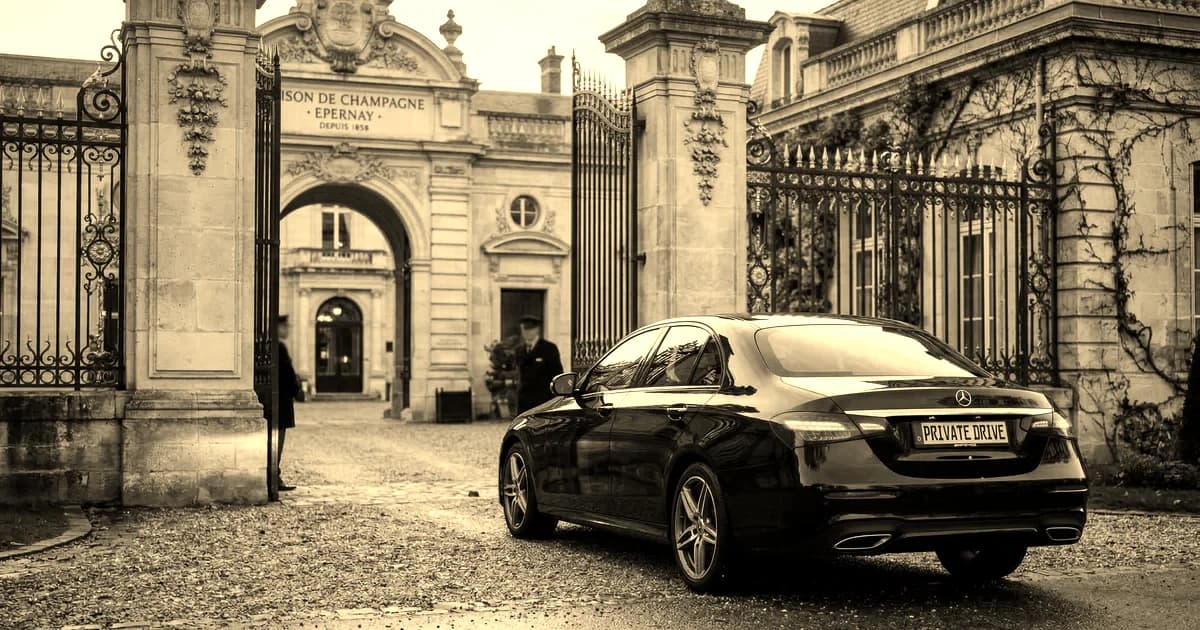
The chalk under Épernay holds five billion euros of wine. You become aware of this fact at the second tasting of the day, somewhere around a vintage 2014 Pol Roger, when the cellar guide opens a door you did not know was there and walks you back into the October daylight. The other people on the tour have a TGV to catch in twenty minutes. You have nowhere specific to be. That asymmetry is the entire reason the Champagne route works as a private chauffeur day from Paris.
140 Kilometres, One Motorway, Two Capitals
The Champagne wine region sits 140 to 145 km north-east of Paris. Close enough for a comfortable day, far enough that the journey itself matters. The A4 carries you out of the eastern suburbs, past Disneyland Paris, then into the rolling chalk slopes of the Marne. Reims arrives in 1h25 by private car, the €15.80 toll included on the PrivateDrive fixed rate. Épernay is 26 km south, on the D951 wine route through the Montagne de Reims, or 25 minutes via the faster N51. The return to Paris in late afternoon runs 1h20 to 1h45, and Friday evenings on the A4 can stretch the second half to two hours.
The TGV from Paris-Est covers the same distance in 45 minutes to Reims, 1h20 to Épernay. It is faster, and it is the wrong instrument for this trip. Once you arrive, you cannot drive between the cellars, into the grand cru villages, or up to a récoltant-manipulant cellar door. The train is built for transit, not for a region.
Why the Driver Defines the Day
A Champagne day is structured around tastings. Multiple tastings, often four to seven pours per cellar, sometimes a vintage flight that includes library bottles. The arithmetic of who is driving home is not negotiable. With a private chauffeur, the question disappears entirely. You taste freely at every stop, including the prestige tiers that justify the trip in the first place.
The driver also absorbs every transition cost the rail itinerary cannot solve. Reims to Épernay through the vineyard plateau, with a five-minute stop at the Verzenay lighthouse for the view across the Pinot Noir slopes. A small detour to a grower in Aÿ. The flexibility to leave a cellar tour 12 minutes late because the guide brought out the rosé. None of this happens with a return ticket. A local chauffeur ranking of day trips from Paris consistently places Champagne in the top tier precisely because the difference between a tour booklet and a real day in the region is the vehicle that waits.
Reims, the Coronation City
Reims is a city of 185,000 with a Gothic cathedral that crowned French kings for nearly a thousand years. The west facade carries one of the most ambitious sculptural programmes in medieval Europe. The Chagall windows in the apse, installed in 1974, are the kind of object you remember a year later when someone mentions stained glass at a dinner party. Entry is free. The cathedral opens 7h30 to 19h30 daily.
Beneath the city, the chalk holds the great houses. Veuve Clicquot runs the Clicquot Experience tours from 09h30 most days, €28 to €45 depending on the tasting tier, 1 to 1.5 hours. Madame Clicquot invented the riddling table here in the 19th century, and the original cellars still wear their first cuts. Taittinger uses 4th-century Roman chalk quarries reworked by Benedictine monks, €22 to €40, the most cinematic of the Reims tours. Ruinart, the oldest Champagne house at 1729, holds UNESCO-listed crayères that demand a three to four week booking lead. The €90 prestige tasting includes library vintages and is the rare cellar visit that rewards the wait. Pommery sits behind a Victorian Gothic surface architecture and runs 18 km of tunnels below.
Épernay, the Most Drinkable Mile in France
Twenty-six kilometres south of Reims, the Avenue de Champagne carries an estimated five billion euros of stock under its 1.5 km length. UNESCO listed the avenue and its hillsides in 2015 as a world heritage cultural landscape. The chalk holds Moët & Chandon, Perrier-Jouët, De Castellane, Pol Roger and a handful of others within a single walk.
Moët & Chandon runs the largest visitor operation, with cellars extending 28 km underground. The standard 2026 tour starts at €48, and the Dom Pérignon tier sits between €100 and €220 for a private experience. Booking three to four weeks ahead is now standard for summer Saturdays. Pol Roger remains by-appointment-only and intimate, the family house that supplied Winston Churchill with a case a month for forty years. Perrier-Jouët trades on Belle Époque iconography and rewards visitors interested in the design history of the bottle as much as the wine. The average Épernay tasting tour runs €73 in 2026, a useful reference point when an aggregator quotes you €120 for a generic experience.
A Real Day Built Backwards from the Return Trip
A day that reads cleanly on the schedule sits inside an 11-hour window from Paris. The shape, with PrivateDrive doors at 08h00, runs roughly like this.
| Time | Move | Note |
|---|---|---|
| 08h00 | Leaves the 8th, A4 east | Route summary in the car if you want it |
| 09h25 | Arrives Reims | First cellar at 09h30 to 11h00 |
| 11h00 to 12h00 | Cathedral | Allow 60 minutes if you read facades |
| 12h15 to 13h30 | Lunch in Reims | Le Millénaire, Brasserie Flo, or Le Jardin des Crayères |
| 13h45 to 14h15 | Montagne de Reims wine route | Verzenay lighthouse stop, Pinot slopes |
| 14h15 to 16h30 | Épernay cellar plus Avenue walk | Moët or Pol Roger |
| 16h30 to 17h00 | Récoltant or Avenue boutiques | Bottles travel home in the boot |
| 17h00 | Departs for Paris | Arrives 18h30 to 19h15. Friday adds an hour |
That sequence is genuinely two cellar visits. The same logic that makes Versailles by private car richer than the train ride applies on a longer scale to Champagne. Three cellars in one day is technically possible and produces a rushed day. Two cellars and a cathedral produces a day people talk about a year later.
The Grower Track Beyond the Grandes Maisons
Roughly 4,000 récoltant-manipulants make Champagne from grapes they grow themselves. The grandes maisons buy fruit across the region and blend at scale. The growers blend within a single estate, often a single village, sometimes a single parcel. The wine reads differently. Three names worth seeking on a bespoke day.
Egly-Ouriet in Ambonnay produces some of the most praised Champagnes globally, Pinot-dominant and structurally serious. Bérèche & Fils in Ludes works biodynamically with extraordinary precision and now sits alongside the historic houses on most critic lists. Marie Courtin in Polisy makes natural Champagnes in volumes so small that allocations are negotiated rather than purchased. Each requires an appointment two to four weeks ahead, and the visits run smaller and longer than the famous tour formats. A driver who knows the back roads through the Aube and the Vallée de la Marne is the difference between a clean grower itinerary and a series of GPS arguments at unmarked gates.
The Vendanges Window
Late August to early October contains the most concentrated atmosphere the region produces. The Comité Interprofessionnel du Vin de Champagne sets harvest start dates per village around fifteen days before grape maturity allows the press to begin. In 2026 that decision sits with the CIVC, watching weather patterns through July and August. Once it lands, the region transforms. Tractors cross the D951 with grape boxes. Press operations run twenty-four hours. Some maisons reduce their visitor programme during the peak fortnight to protect the work. Others run dedicated harvest tours that cost more and book out fast.
The trade-off is real. A vendanges visit captures the region in the act of producing what you taste. It also runs against shorter cellar windows and full hotel pressure. A private driver day collapses the difficulty: you arrive when the booking allows, the cellar accepts you on its own schedule, and the walk among the press operations becomes a flexible afternoon rather than a logistics problem.
The Seasonal Calendar Worth Reading Before Booking
The region rewards different kinds of visits at different points in the year. The chalk cellars sit at a constant 10 to 12°C regardless of what is happening above ground.
| Season | What it offers | What it costs |
|---|---|---|
| March to May | Vines budding, thin crowds, ideal cellar temperatures | Outdoor dining limited, smaller producers still closed |
| June to August | Full foliage, long days, full programme open | Peak tourist season, four to six weeks ahead for grandes maisons |
| September to October | Vendanges atmosphere, vines in colour, presses running | Some standard tours reduced, premium tours sell earlier |
| November to February | Quietest months, most intimate cellar experiences | Cold above ground, some outdoor venues closed |
April to May is the second-best window after the harvest. It also pairs well with a longer trip that includes a Giverny day for the gardens at peak iris season, since the two day trips work back-to-back without the fatigue of consecutive long-haul flights.
What the Driver Carries That the Train Cannot
A Champagne day with PrivateDrive runs on a fixed price. The full-day sedan rate sits at €1,000 from Paris and back, three passengers, ten to twelve hours, one car, one driver. The V-Class for four to seven passengers runs €1,300 in the same window. The fare includes the A4 toll, the Marne tolls, parking on the Avenue de Champagne, and the climate-controlled boot that is the second-most-useful feature of the day after the driver who waits.
That climate-controlled boot matters more than most visitors expect. A grower allocation negotiated in Ludes does not survive an 18°C train carriage on the way home. Six bottles of vintage held at 12°C all afternoon return to Paris in the same condition they left the cellar. The driver also pre-routes around the Friday A4 evening peak and adapts in real time to lunch overruns, an extra grower stop, a late departure when a cellar guide brings out the older bottles. The argument for what arrival quality does to the rest of a Paris trip applies in reverse on the way out: the way you leave the city for Champagne shapes what you bring back.
A Day With a Measurable Cost of Doing It Badly
A Champagne day from Paris is one of the few day trips in the region where the cost of doing it badly is a measurable loss. Cellar bookings squandered to a missed connection. A €90 Ruinart tasting cut in half because the next train leaves at 16h12. Bottles bought at the cellar and broken on the way home. Each of these is the absence of the same thing: a car that knows where it is going, a driver who is not on a meter, and a fixed rate that does not flex with the weather. For a 72-hour Paris stay where Champagne is one of three set pieces, that fixed rate is also the only way to compose the trip without leaving the cellar tour reservations to chance.
Book your Champagne day trip with PrivateDrive. Full day from €1,000. Sedan, SUV or V-Class. Mountain of Reims wine route, two cellar visits, your pace. Provide the cellar bookings and we handle the rest.