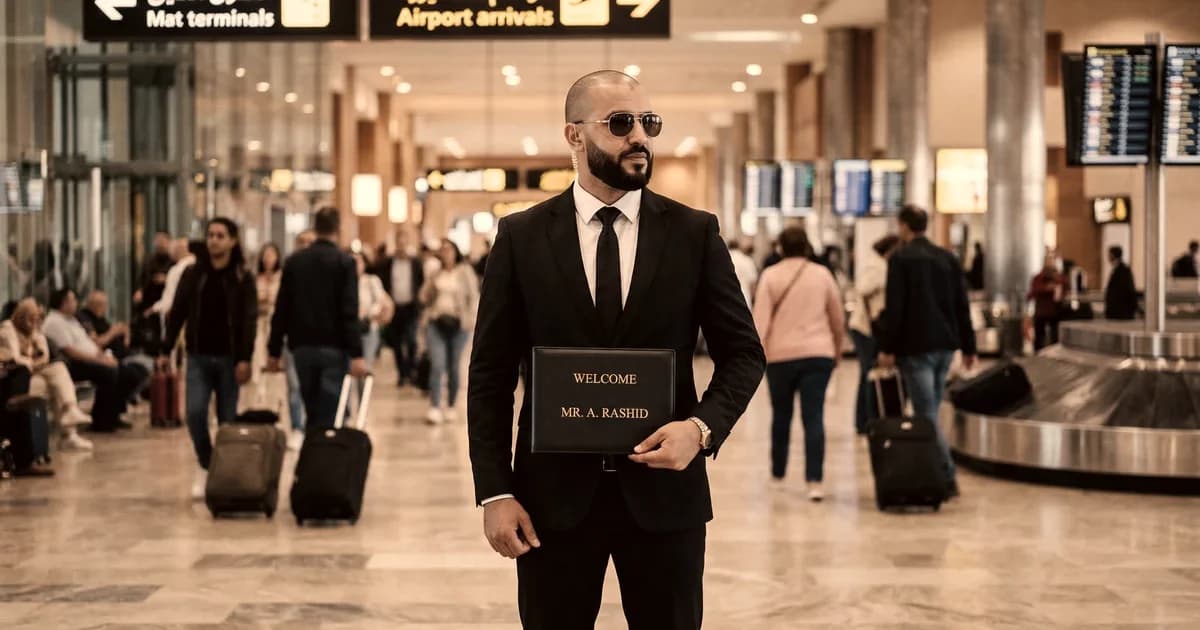
Paris is a city that rewards a particular kind of attention. Its pleasures are not accidental. They are composed. The quality of a croissant depends on the choice of butter. The view from a room depends on which floor you book. The feeling of a week in Paris depends, more than most travellers acknowledge, on how it begins.
Your transfer from the airport or train station is not a logistical footnote. It is the first chapter. And like the first page of a great novel, it establishes tone, mood and expectation for everything that follows. A luxury arrival in Paris, done well, signals to the nervous system that you have left ordinary travel behind.
The psychology of arrival
Behavioural economics and hospitality research have converged on a single, inconvenient finding. The beginning of an experience disproportionately shapes how you remember the whole of it. Cornell’s Center for Hospitality Research identifies arrival as the highest-impact moment in a guest’s experience, more influential than room quality, meals or price.
The implication is concrete. How you arrive in Paris matters more to your overall perception of the trip than most choices you will make during it. Take two versions of the same scenario. A flight from New York lands at CDG at 07:30. Version one: you join the taxi queue, wait 25 minutes, negotiate with a driver who doesn’t speak English, load bags into a cramped cab, and watch Paris appear through a dirty window while you try to remember the hotel address. Version two: a chauffeur is at the arrivals exit holding your name, takes your bags, leads you to a cool, silent Mercedes, and drives you into the city while you recover from the flight.
Both passengers reach the same hotel at roughly the same hour. Their Paris, already, has diverged.
What April 2026 changed
The arrival calculus shifted in April 2026, when the EU Entry/Exit System went live at the bloc’s external borders. Non-EU travellers now have four fingerprints and a facial photograph captured on every arrival and every departure. At CDG the afternoon arrival bank at Terminal 2E has been documented processing roughly 35% fewer passengers per hour than the kiosks were dimensioned for, and queues past two hours have been reported repeatedly since the rollout. ACI Europe and several airline bodies have asked the Commission to give border police the option to suspend biometric capture once queues exceed 45 minutes.
What this means for a Paris arrival is not philosophical. The 45 minutes you spend in a car between CDG and your hotel are now the one segment of the journey you can still shape. The immigration queue is governed by a kiosk’s frame rate. The baggage carousel is governed by ground handling schedules. The only part of the arrival that still rewards choice and preparation is the transfer itself, which is precisely why it matters more, not less, than it did a year ago. The operational primer on the meet and greet protocol covers the landside name board that removes the last variable.
What a premium transfer actually provides
A quality private transfer is not simply faster or more comfortable than a taxi. The differences are structural.
Certainty
You know, before you land, that someone is waiting. Flight tracking means the driver adjusts in real time to delays. The single greatest source of arrival anxiety, the uncertainty of whether transport will be there, is eliminated before you board.
First-impression management
For business travellers, the transfer is often witnessed by colleagues or clients. Arriving in a maintained, late-model vehicle, welcomed by a discreet professional chauffeur, communicates preparation. Hotels, restaurants, private dining rooms and corporate receptions operate on cues. The car at the kerb is one of them.
The decompression window
The 45 to 60 minutes between CDG and central Paris become, in the best version of a transfer, a genuine transition period. The cabin is quiet. The air is clean. There is water. The driver does not need anything from you. This is the time you use to close your eyes, review your schedule, or simply watch Paris materialise from the motorway, the banlieues giving way to Haussmann’s avenues, the golden stone buildings, the Seine.
Local intelligence
A good chauffeur knows the city. Which arrondissement your hotel sits in. What the traffic pattern looks like at 17:45 on a Friday in the 16e. Which entrance the Meurice uses for luggage and which one the Crillon prefers for its cars. Small things, each one a micro-friction removed, each one fatigue you do not carry into dinner.
The details that signal quality
Premium arrival experiences are built from specifics, not generalities. The standard at PrivateDrive includes:
- Personalised name board at the arrivals hall, landside, held by the driver who also confirms your booking details.
- Door-to-door service, luggage carried, terminal car park navigation handled for you.
- Chilled mineral water as standard in every vehicle.
- Real-time flight tracking with automatic adjustment for delays, ATC holds and gate changes.
- English-speaking chauffeurs on every transfer, with French, Spanish, Italian or Arabic on request.
- Fixed pricing confirmed at booking, no meter anxiety, no surge, no ambiguity.
For clients who request it, PrivateDrive arranges newspapers, specific beverages, a mobile charger, an infant seat or other on-board preferences with 72 hours of notice.
For a direct journey between CDG and Paris, the regulated 2026 Paris taxi fare is €56 to the Right Bank or €65 to the Left Bank, excluding applicable regulated supplements. It does not become a different airport flat fare at night or on Sundays. A PrivateDrive sedan starts at €150, with a dated quote that reflects the route, time and selected options, plus flight monitoring, a public-arrivals meeting and luggage assistance. Our 2026 pricing guide explains the differences in service; the taxi figures are published by Service Public.
The routes that reveal the city
There is genuine pleasure in a well-driven route into Paris. CDG to the 8e via the A1 is efficient. But your chauffeur can, on request, take you in via approaches that introduce you to the city’s texture earlier.
The classic entry via Porte de la Chapelle. You enter Paris proper at the base of Montmartre, the Sacré-Cœur appearing briefly to the left, then down through the old working quarters of the 18e before the city begins to show you its bones.
The southern approach from Orly via the périphérique. The Left Bank skyline materialises slowly, and suddenly the Eiffel Tower is there, impossible and inevitable.
From Gare du Nord or Gare de Lyon. You are already in the dense heart of the city, and the transfer becomes about the quality of those first five minutes in traffic, the window open to Paris air. The Eurostar transfer playbook covers the Gare du Nord case in detail.
Tell your driver what you want. The good ones know how to show you the city.
Paris as a first act
The city asks something of its visitors. It asks that they arrive ready to engage, ready to be present. Paris is poorly experienced from behind a windshield of stress. It opens only to those who have arrived calmly enough to notice it.
The hotels that understand this have understood it for decades. The Peninsula Paris keeps a house fleet of a Rolls-Royce Phantom and Mini Coopers on Avenue Kléber, not as marketing flourish but as an extension of the lobby. The Ritz adjusts arrival timings to the minute on request, coordinating the flight, the transfer and the room preparation as one sequence. The Hôtel de Crillon, reopened under Aline Asmar d’Amman’s restoration, treats the threshold to Place de la Concorde as the first interior space of the stay. A private transfer extends that philosophy outward, beyond the hotel entrance, to the airport or station where the experience actually begins.
For travellers using Paris as a base for the rest of the week, the 72-hour chauffeur-driven itinerary picks up where the arrival transfer sets down. For the executive whose arrival is in fact the business day, the board meeting logistics guide treats the same 60 minutes as a pricing and risk problem.
The arrival decides what is possible that first evening
Paris is generous to travellers who land composed and merciless to those who do not. The 45 minutes between the arrivals hall and the hotel room key are not a passive interlude. They are the lane that determines whether the first dinner reservation is a pleasure or a survival exercise. In the post-EES world, where passport control has absorbed most of the remaining variance in the day, the transfer is where the remaining preparation lives. Book it as if the trip depended on it. More often than most travellers acknowledge, it does.
PrivateDrive treats the arrivals hall as the first node of the ritual: the name board you see when you step through, the quiet Mercedes at the kerb, and a driver who knows which arrondissement you are going to before you have given the address a second time.