Key takeaway
Navigate Paris's 2026 Michelin landscape by private car: where stars cluster after L'Ambroisie's demotion, multi-restaurant evenings, booking realities.
Paris woke up on 16 March 2026 to the most consequential Michelin announcement of the decade. L'Ambroisie, the restaurant that had held three stars on the Place des Vosges without interruption since 1988, dropped to two. The departure of Bernard Pacaud at the end of July 2025, the acquisition by businessman Walter Butler, the installation of chef Shintaro Awa in the kitchen: those were the three quiet decisions that landed in print on a Monday morning and reshaped the geography of the city's highest-tier dining. Paris closed 2026 with nine three-star restaurants and one of the oldest names in French haute cuisine wearing two.
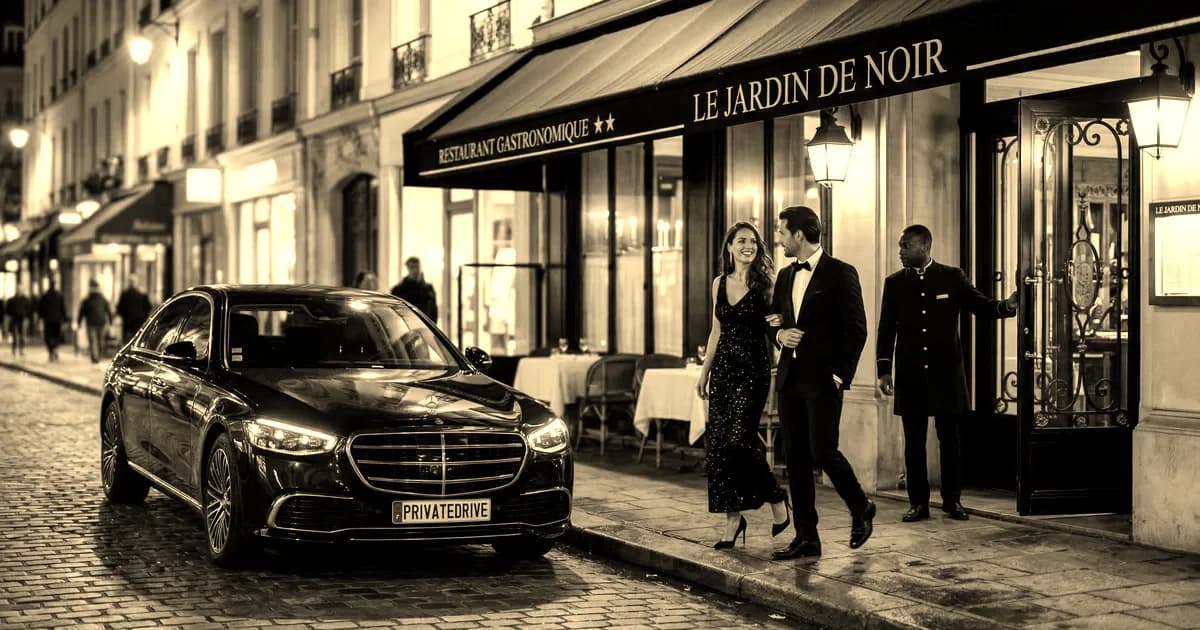
That matters operationally as much as gastronomically. A private driver evening that used to put L'Ambroisie at the centre of a three-restaurant progression now repositions around Plénitude at Cheval Blanc Paris, around Kei in the 1st, around the cluster of palace-hotel three-stars in the 8th. For visitors planning a serious gastronomy trip in 2026, the booking sequence and the route between addresses both shift. The car outside the door becomes the architecture that holds the evening together.
The 2026 Map That Got Redrawn in March
The Michelin Guide France 2026 lists 31 three-star restaurants nationally, 84 two-star and 553 one-star, for 668 stars in total. Paris holds nine of those three-stars after the L'Ambroisie demotion. Across the city the count tips toward 100 starred addresses when the surrounding Île-de-France additions and the new entries in the 11th arrondissement are folded in. The density per square kilometre remains the most concentrated in Europe.
The nine three-star addresses for 2026 are: Alléno Paris au Pavillon Ledoyen, Arpège, Épicure at the Hotel Bristol, Le Cinq at the Four Seasons George V, Le Gabriel at La Réserve Paris, Pierre Gagnaire, Le Pré Catelan in the Bois de Boulogne, Kei in the 1st, and Plénitude at the Cheval Blanc Paris. Of those, six sit within the 8th arrondissement or its immediate orbit. The remaining three reach into the 1st (Kei, Plénitude) and the 16th (Le Pré Catelan).
The Four Seasons George V holds six Michelin stars across its three restaurants in the 2026 guide, the highest single-hotel total in Paris. The Bristol's Épicure retains its third star and its 18th-century courtyard. La Réserve's Le Gabriel held its position through one of the more volatile sets of executive chef transitions in the city. None of this is random. Each address survives in the three-star tier because of an operational discipline that extends from kitchen to service to the timing of the car at the front door.
Where the Stars Cluster When You Have Three Hours
An evening with one starred restaurant collapses neatly into a single transfer pattern: hotel to address at 19h30, dinner from 20h00 to 23h30, return to hotel. This is exactly what hourly chauffeur hire is for: the driver stays in the area, parks within reasonable distance, returns when the kitchen sends out its mignardises. Three hours of dining, four hours of car booked, no logistics visible to the diner.
An evening with two restaurants requires geography. Two addresses within the 8th, or two addresses within walking distance of each other, work without complication. Two addresses split between the 8th and the 1st require a fifteen minute drive between them. Two addresses split between the 8th and the 11th require thirty. The wine list begins to interact with the route. A driver who knows that Septime in the 11th runs its first seating until 21h30, and that Arpège in the 7th seats from 19h30, sequences the evening so the diner never feels the timing.
Three restaurants in one evening is a logistical pattern rather than a culinary one. Aperitif and starter at one address, main and cheese at a second, dessert at a third. Total drive time stays under 45 minutes across the evening when all three sit within a 15-minute radius. The format works for diners who have already done the standard tasting menu evenings and want a different rhythm. It does not work without a driver who can absorb the timing variance every kitchen introduces.
Two Restaurants in One Evening Without Losing the Wine
The most common multi-restaurant pattern is not three addresses. It is two. An aperitif and starter at one of the smaller intimate addresses (Hémicycle at one star, David Toutain at two, Auguste in the 7th), then main and cheese at one of the heavier palace-hotel houses (Le Cinq, Épicure, Pierre Gagnaire). The evening covers two distinct culinary philosophies in three hours. The driver moves once between them.
For this pattern to work, the second restaurant has to know that the table arrives at 21h00 ready for a main course rather than at 19h45 starting from scratch. Most starred Paris houses accommodate this when notified in advance through a hotel concierge or directly by the operator coordinating the evening. The kitchen adjusts the courses delivered, the sommelier shifts the wine pairing to start with the red, the service strips out the place setting that would have come with the missing first courses. None of that happens with a walk-in. All of it happens when the booking has been laid out properly.
Paris-based hotel concierges at the palace tier (the Ritz, the Bristol, the George V, the Cheval Blanc, the Crillon, the Plaza Athénée, La Réserve) maintain the relationships that make this kind of sequencing possible. So do the small handful of independent operators who work the same network. The route the evening takes from address to address, and the briefing the driver receives at booking, are the operational expression of those relationships. The way an arrival sets the tone for Paris applies as much to the door of an 11th-arrondissement bistronomy address as it does to the lobby of the Ritz.
The Bottle You Cannot Have if You Are Driving
The wine lists at Paris's three-star restaurants exist on their own terms. A 1990 Romanée-Conti from Alléno's cellar, a Krug Clos d'Ambonnay from Le Cinq, a magnum of Yquem 1989 from L'Ambroisie's reserve list: these are not bottles selected for value or for what they pair with the menu. They are bottles served because the kitchen built a tasting around them and the cellar made them possible. Drinking one with the responsibility of a return drive afterwards turns a cultural moment into a calculation.
The driver outside the door removes the calculation. The Burgundy by the glass becomes the Burgundy by the bottle. The Sauternes with the dessert becomes a second Sauternes with the cheese. The eau de vie that the maître d' brings out at 23h45 is a yes rather than a polite refusal. The economics of what you ordered at the table do not bleed into the practicalities of how you got home. That is the entire point of booking a driver for an evening of this category. It is also the difference between an evening that closed properly and one that closed under constraint.
Booking Reality After the 2026 Guide
Septime in the 11th remains the hardest one-star reservation in Paris. Reservations open on the first day of each month for the following month, online only, at 09h00. Anyone serious about the table is on the website at 08h55. The system clears within minutes. The 2026 Michelin Guide kept the star, kept the queue, and kept the operational rhythm that Bertrand Grébaut's team has held for over a decade.
The three-star palace addresses (Le Cinq, Épicure, Pierre Gagnaire, Plénitude) take bookings two to four weeks ahead for direct guests. A concierge introduction or a hotel guest's request often surfaces the same evening's residual tables that have not made the public availability calendar. The Bristol's Épicure team and the George V's Le Cinq team work routinely with the palace concierge network. Outside that network the booking calendar tightens earlier.
L'Ambroisie after March 2026 sits in an interesting position. The two-star price point is similar to the three-star one. The booking window has widened: tables that would have been impossible to obtain in 2025 now release more freely as the demand recalibrates around the new tier. Shintaro Awa's first full year in the kitchen runs through 2026, and several critics have already placed his food back at the upper end of two-star Paris. The booking discipline that L'Ambroisie was known for (telephone only, concierge-introduced, walk-ins rejected by default) remains. The accessibility, modestly, has improved.
New stars for 2026 from the 16 March announcement include Vaisseau in the 11th, where Adrien Cachot's "blind" menu earned its first star, alongside several other east-Paris additions. Reservations for these addresses still book one to two weeks ahead through 2026, though the pattern will tighten as the year progresses.
A Week of Stars: What a Real Itinerary Looks Like
A serious gastronomy week in Paris in 2026 stitches together palace-hotel three-stars, 6th and 7th arrondissement icons, 11th arrondissement bistronomy, and a deliberate evening of multi-restaurant progression. The pattern below assumes a guest staying at one of the palace hotels with a driver booked for the week.
Monday. Septime (one star) in the 11th. Book exactly one month ahead. Driver picks up at 19h45, arrives by 20h15, returns at 22h45. The dinner runs longer than the booking slot in roughly four cases out of ten. The driver waits.
Tuesday. Le Cinq (three stars) at the Four Seasons George V. Palace-hotel grandeur, the courtyard table if available, full tasting menu with wine pairings. The driver stays in the 8th, returns at 23h30.
Wednesday. Arpège (three stars) in the 7th. Alain Passard's vegetable-forward menu, the most distinctive three-star tasting in Paris, an experience that runs four hours minimum from start to mignardise. Book through a Paris concierge.
Thursday. A progression evening across three 11th-arrondissement addresses: aperitif and starter at Vaisseau (one star) for an early seating, mains at Amalia (one star), dessert at a wine bar with a curated digestif programme. Total drive time across the evening sits at 35 minutes. The driver manages the timing between kitchens.
Friday. L'Ambroisie (now two stars, Place des Vosges, 4th arr.). Reserve through a Paris-based concierge with a working relationship. The room remains one of the most intimate haute cuisine settings in the city. The kitchen under Shintaro Awa is producing food that the 2027 guide will look at carefully.
Saturday. A long lunch at Le Jules Verne (two stars) inside the Eiffel Tower. Reserve weeks ahead. Daylight tasting menu, panoramic view, a different rhythm from the evening pattern of the rest of the week. Afternoon free for a walk in the 7th.
Sunday. A single dinner at Plénitude at the Cheval Blanc Paris (three stars), overlooking the Seine. Arnaud Donckele's tasting menu is built around sauces that have become the technical reference point of the contemporary three-star kitchen. The evening closes the week.
Total stars across seven evenings: fourteen. Driver evenings booked: seven, including three multi-pickup packages and four single-restaurant returns. The 72-hour itinerary by chauffeur covers the shorter compression version of the same logic when the visit shrinks to a long weekend.
The Cost of an Evening, and the Cost of Doing It Right
| Service | Vehicle | Duration | Rate |
|---|---|---|---|
| Single-restaurant evening (hotel return) | Mercedes E-Class | 3 hours | According to the dated quote |
| Two-restaurant progression | Mercedes E-Class | 4 hours | According to the dated quote |
| Three-restaurant progression | Mercedes E-Class | 5 hours | According to the dated quote |
| Full evening, S-Class with palace pickup | Mercedes S-Class | 5 hours | According to the dated quote |
| Group evening (4 to 6 diners) | Mercedes V-Class | 5 hours | According to the dated quote |
| Hourly extension beyond package | Any vehicle | Per hour | According to the dated quote |
The pricing reflects 2026 fixed-rate structures for evening dining in Paris from a premium operator. The 2026 reference for Paris private transport pricing sets the benchmark for the rest of the categories. The premium over a standard transfer is for the wait time, the second pickup, the absence of a meter ticking while the dinner runs forty minutes past schedule.
Compare the same service: separate taxi journeys and an hourly chauffeur booking do not cover the same waiting or availability. With PrivateDrive, agree on the booked duration, vehicle and inclusions. Extra time requires availability and confirmation of the applicable extension price; it is not automatically billed at the original hourly rate.
The Practical Reason a Driver Sits Outside
Every Michelin starred restaurant in Paris faces the same operational reality at 23h00. The kitchen is closing. The maître d' is sequencing the final tables out. The cloakroom is congested. The street outside, particularly on a Friday or Saturday, has more diners than available taxis. Five minutes of standing on Avenue Montaigne at 23h15 in November in evening dress with a partner who has just finished a tasting menu is enough to undo the entire evening's atmosphere.
Coordinate your departure with the chauffeur before the restaurant visit ends. If dinner runs beyond the booked return time, contact the team to check availability and any extension charge. A reservation makes the plan explicit; it does not make the vehicle available without a time limit.
For an evening that involved cooking at the level of a Champagne masterclass, or for a city visit that combines a starred dinner with day trips from Paris during the same week, the driver outside the door is the connecting infrastructure. The evening reads as a single uninterrupted experience because the logistics never reach the diner. The cost of the package is the cost of removing every variable that would otherwise sit on the wrong side of an extraordinary dinner.
Request an evening with PrivateDrive. Choose the vehicle and allow enough time for the restaurant bookings, travel and return. Check the dated quote and service conditions, then confirm any additional time before extending the evening.
Related Destinations
Related Articles
Paris Museum Tour by Private Driver: Louvre, Orsay, Rodin
lifestyle-luxeParis Shopping Day: Private Driver, Le Marais to Montaigne
lifestyle-luxeParis Night Tour: A Private Chauffeur Evening Itinerary
lifestyle-luxeThe Art of Arriving in Paris: Your Transfer Sets the Tone
lifestyle-luxe72-Hour Paris Itinerary by Private Chauffeur
excursions-destinationsChampagne Route: Reims & Épernay by Private Driver
Also on this topic:Paris Airport Transfer Pricing 2026: Real Costs.