Key takeaway
Your inbound flight to CDG is delayed three hours. Here is what happens to your chauffeur, your fare, your wait, and what EU261 actually covers.
Three hours late inbound to Charles de Gaulle is not a rare event. The scenario plays out several hundred times a week at one of Europe's busiest continental hubs, and the gap between a passable arrival and an expensive recovery sits almost entirely in what your ground transport provider already knew the moment the departure board flipped to DELAYED. There are three parts to that. The mechanics of how a chauffeur service tracks and adapts to your delay. The EU261 protections that apply, and the ones that stop short. The practical reality of CDG itself, which is going to look different by spring 2027.
The short version is that pre-booked private transfer absorbs almost all of the disruption, taxi and rideshare absorb almost none of it, and there is a narrow band of edge cases where airline-side decisions and traveller-side ones interact in ways worth knowing before the day of travel.
What EU261 Pays For, and What It Does Not
For any flight departing the European Union, or operated by an EU carrier into Paris, Regulation 261/2004 has applied to delays since 2004. A three-hour delay at the final destination triggers cash compensation per passenger on a sliding scale by distance.
Short-haul under 1,500 km pays €250. Medium-haul from 1,500 to 3,500 km pays €400. Long-haul above 3,500 km on routes with an EU leg pays €600. From the two-hour mark, separately from any compensation calculation, the airline must provide meals, refreshments, and means of communication. For delays that run overnight, accommodation and hotel-airport transfers fall on the carrier. Claims for flights departing France carry a five-year statute of limitations.
The carve-out worth knowing is the "extraordinary circumstances" exemption. A strike by the airline's own crew does not qualify and remains compensable. Air traffic control strikes do qualify, which is why the 14-16 May 2026 SNCTA action across French ATC facilities, and the wider sequence around CDG's avoided 2 May ground-movement stoppage, paid no cash compensation even when they cascaded into multi-hour delays. The care obligations (meals, hotel, transfers) still apply during ATC strike days.
A separate item has been moving in Brussels. The European Council has taken a position on amending EU261 so that the compensation threshold would move to four hours for intra-EU and short-distance routes and six hours for long-haul, with the long-haul amount dropping from €600 to €500. The proposal is not yet law. As of mid-2026 the three-hour threshold still applies, and the existing distance grid still stands. Worth checking on the day if your delay slips in at the threshold edge.
How a Real Chauffeur Service Tracks Your Flight
The structural difference between a private chauffeur and a taxi or rideshare app is what happens before you land, not what happens at the kerb.
Flight tracking is activated at booking. Your driver knows your flight number, your origin airport, and your scheduled arrival before the day of travel begins. If a delay surfaces six hours out, the dispatch slot moves with it. If it surfaces two hours out, the same logic applies. Pickup time adjusts continuously against the live arrival forecast rather than the original schedule. There is no fixed-departure window that strands you the moment your inbound flight slips.
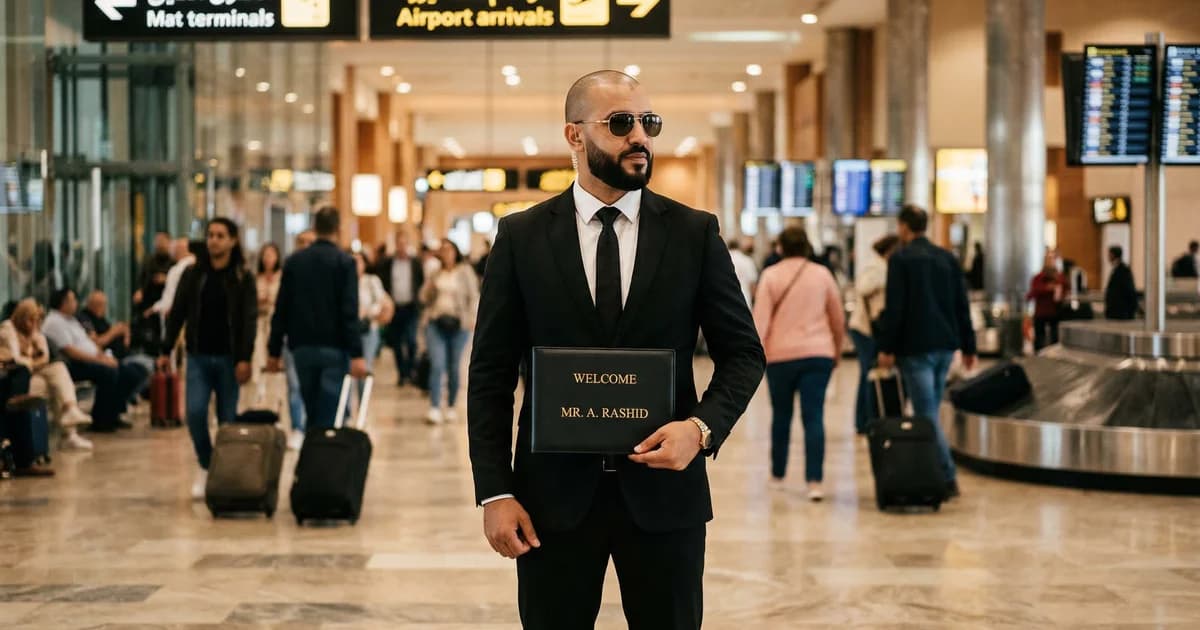
The meeting point is inside the arrivals hall, not outside in a parking bay or at a generic kerbside drop-off. For non-Schengen international arrivals at CDG, that places the driver past baggage claim and customs, name board in hand in the public greeting zone. The wait inside that window is not billed against the original schedule. PrivateDrive includes 60 minutes of complimentary wait from the actual landing time, which absorbs the realistic deplane-to-arrivals-hall sequence even at the slow end of the distribution.
A delay that pushes your arrival past midnight can move the booking into a different pricing band if the contract specifies a late-night surcharge. A well-run operator surfaces that before the booking is confirmed, not after the driver has waited four hours. The 2026 reference grid for Paris airport pricing sets the daytime versus night-tariff differential explicitly.
The CDG Terminal Map, and the Renaming Coming in March 2027
CDG operates three terminal complexes and eleven separately named halls. Confusing one for another costs time on any arrival and significant stress on a delayed one.
Terminal 1, the original circular building, handles Star Alliance carriers including Lufthansa, Swiss, and United. Arrivals are on the fifth floor; the driver meetpoint is in the arrivals hall after customs.
Terminal 2, which sees most of the traffic, runs from 2A through 2G and is split by alliance and route type. 2E handles long-haul Air France to New York, Los Angeles, and Asia, and houses the airport's largest international arrivals concourse. 2F handles many transatlantic routes and most of Air France's African network. 2A and 2C cover European destinations. 2B, 2D, and 2G split between regional and short-haul European traffic.
Terminal 3 is the low-cost and charter terminal (Ryanair, easyJet), smaller and faster to exit.
According to SNCF Gares & Connexions, the free CDGVAL train operates from 04:00 to 01:00, with replacement buses from 01:00 to 04:00. A late terminal change does not mean you should cross the airport yourself: send the new arrival details to the chauffeur and confirm the public meeting point before moving.
The map is going to change. Groupe ADP will renumber every CDG terminal in March 2027, dropping the letter-suffix system in favour of a continuous Terminal 1 through Terminal 7 sequence. From September to December 2026, more than 3,000 terminal signs, 600 parking signs, and 250 roadway signs will be installed under temporary covers, then revealed in a single operation in March 2027 to coincide with the CDG Express rail link opening. Current Terminal 1 stays Terminal 1. Terminal 3 becomes Terminal 2. Terminals 2A and 2C become Terminal 3. Terminals 2B and 2D become Terminal 4. Terminal 2E (including its EK, EL and EM halls) becomes Terminal 5. Terminal 2F becomes Terminal 6, and Terminal 2G becomes Terminal 7. Airlines selling tickets a year in advance began incorporating the new names in March 2026, so an inbound boarding pass for late 2027 onwards already carries the new numbering. Confirm both the old and new identifiers with your chauffeur if your travel sits in the transition window. The CDG terminal navigation guide covers the operational consequences in more depth.
Three Hours at CDG: How to Spend Them
A three-hour delay is the wrong length to sit at the gate scrolling. It is the right length to use CDG's facilities deliberately.
Lounge access through Priority Pass, Lounge Club, or a premium card's airline arrangement is available across Terminal 1, Terminal 2E, and Terminal 2F. Air France runs its own lounges in 2E and 2F for Business and SkyTeam Elite Plus passengers. None of these require a same-airline boarding pass; the membership is enough.
For dining outside the lounge envelope, the Relay shops and the Jamie Oliver Kitchen in 2E remain reliable. Le Café du Commerce in Terminal 1 is calmer than the 2E concourses during evening rush. Duty-free in the 2E/2F zone covers nearly 30,000 square metres, with meaningful price differences on fragrance and high-end spirits relative to UK and US retail.
Wi-Fi is free across all CDG terminals on a single sign-in. The signal is reliably better in the seating zones near lounge entrances than in the central concourse aisles, if a video call is the actual goal of the next hour.
Landing to Arrivals Hall: The Real Number
The headline transfer-service quote of "forty-five minutes from landing to pickup" is consistently too short for CDG. The realistic distribution by passport type is the right planning number.
| Passenger Type | Typical Time from Landing to Arrivals Hall |
|---|---|
| Schengen EU passport | 20 to 40 minutes |
| Non-Schengen EU passport | 30 to 60 minutes |
| US, UK, Australia (EU e-gate eligible) | 45 to 75 minutes |
| Non-e-gate passport (manual processing) | 60 to 120 minutes at peak |
Add luggage wait, which at CDG sits between 20 and 40 minutes (longer on widebody arrivals into 2E), and the total floor-to-pickup window runs 60 to 120 minutes for most international travellers.
This window expanded modestly through 2026 as the EU's Entry/Exit System (EES) biometric checks rolled into operation. April 2026 saw the EES collide with French ATC stoppages and produce a Paris-wide cluster of widely reported delays, including a single twenty-four-hour window with over 190 individual flight delays at CDG. PrivateDrive's 60-minute complimentary wait from landing is calibrated to this reality. It is not a marketing line; it is what the data actually requires.
The Strike Question, and Why Pre-Booking Still Helps
Summer 2026 is on track to be the most active French ATC strike season in a decade. The 2 May stoppage at CDG was averted by an overnight union deal; the 14-16 May nationwide SNCTA action covering all French ATC facilities was not, and the union has signalled further action across the summer schedule.
For inbound flights cancelled or rerouted during a strike, the chauffeur side of the equation is the simpler half to solve. A flight rerouted from CDG to Orly is a transfer amendment, not a cancellation; the driver redeploys. A reroute to Beauvais (Ryanair's principal Paris airport) creates a longer ground transfer that needs a phone call rather than a re-booking. A diversion to Brussels or Frankfurt is a different category and usually surfaces a hotel-and-rebooking decision tree on the airline side before a ground transfer becomes useful again.
The point of pre-booking, in a season this disrupted, is not that the chauffeur magically fixes the airline disruption. It is that the chauffeur is the part of the day that does not also fail at the worst moment. The CDG meet-and-greet protocol sets out the on-the-ground sequence in more detail.
What Pre-Booking Buys at One in the Morning
The worst version of a delayed CDG arrival is the one where 200 passengers from a long-haul widebody walk into a closed taxi queue at one in the morning and discover their booked ride was a rideshare with no flight tracking. The driver was on a different fare an hour ago, the surge multiplier has tripled, and the four people who pre-booked through a professional chauffeur service are already on the périphérique heading to their hotels. The executive assistant playbook for Paris ground transport makes the same point from the corporate travel buyer's angle.
The economic logic favours pre-booking in proportion to the volatility of the flight. A predictable Schengen domestic at 11 AM rarely repays the planning. A long-haul widebody landing in a French ATC strike window, or a CDG connection with two hours of ground time and no margin, makes the pre-booking equation almost unilaterally favourable. The travel insurance industry has been pricing this differential into corporate policies for several years. The traveller-side calculation should match. The CDG connecting-flight transit guide walks through the connection scenario specifically.
Book your CDG transfer with PrivateDrive. Flight tracking activated at booking, 60 minutes complimentary wait from landing, English-speaking chauffeurs, Mercedes E-Class, S-Class, and V-Class fleet, fixed €125 fare from CDG to central Paris. The car waits for the flight, not for the clock.
Related Destinations
Related Articles
Paris Airport Transfer with Kids: 2026 Family Guide
transferts-aeroportParis Airport Transfer with a Baby: Car Seat Rules
transferts-aeroportLate-Night Paris Airport Transfer: 2026 Arrival Guide
transferts-aeroportConnecting Flights via Paris: CDG Transit Transfer Guide
transferts-aeroportParis Airport Meet & Greet: What It Actually Includes
transferts-aeroportCDG Terminal 1 vs Terminal 2: Transfer Guide
Also on this topic:Paris Airport Transfer Pricing 2026: Real Costs, CDG Monday Morning: The Business Travel Survival Guide, Paris Summer Airport Transfer: July and August 2026, Paris Airport Transfers During Strike Season: What Works, Le Bourget vs CDG: The Private Aviation Decision in 2026.