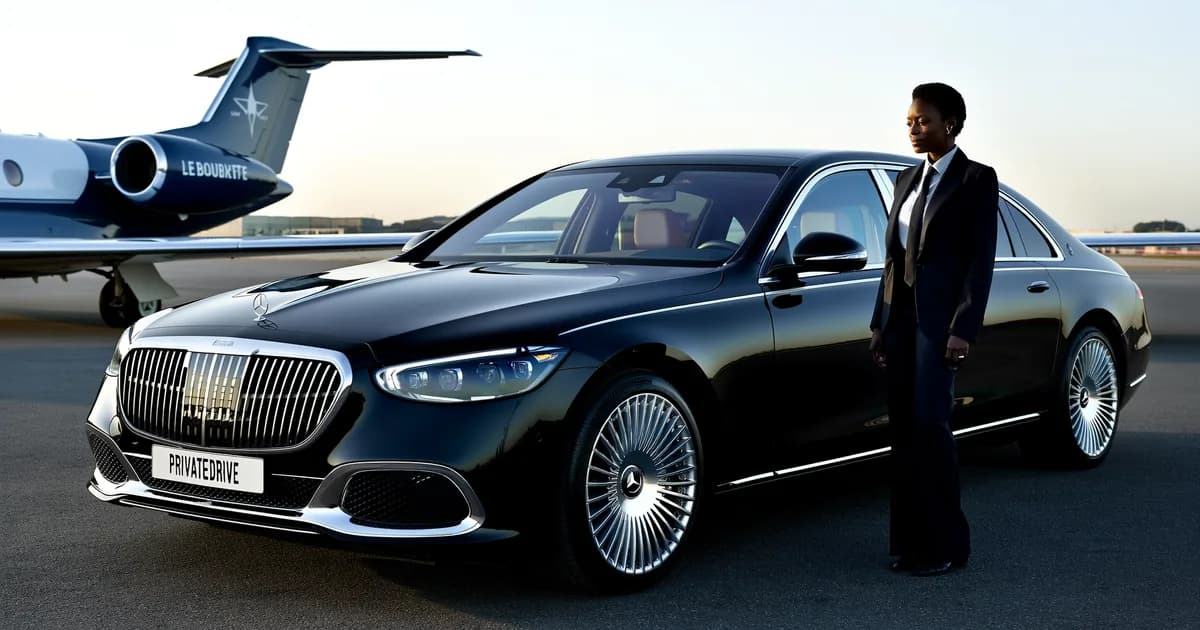
There are two ways to arrive in Paris. One involves Terminal 2E at Charles de Gaulle, immigration queues, baggage carousels, and a taxi rank. The other involves a Falcon 7X touching down at Le Bourget, a customs officer who comes to you, and a Mercedes waiting on the tarmac.
Le Bourget is not a secret. It is the busiest business aviation airport in Europe, handling over 26,000 movements per year. But despite its volume, it operates with a discretion that commercial airports cannot match. There are no departure boards, no crowds, no announcements. Your name is on a manifest, your car is on the apron, and the transition from aircraft to city takes minutes, not hours.
This guide is for the traveler, or the executive assistant planning for one, who wants to understand how Le Bourget actually works, what to expect on arrival and departure, and why the ground transport decision matters more here than at any other airport near Paris.
A Brief History of Le Bourget
Le Bourget’s history is inseparable from aviation itself. It was Paris’s first commercial airport, operational from 1919. Charles Lindbergh landed here in 1927 after the first solo transatlantic flight. The terminal building from that era, now the Musée de l’Air et de l’Espace, is one of the finest aviation museums in the world, housing a Concorde, a Boeing 747 cross-section, and aircraft dating back to the pioneers.
When Charles de Gaulle Airport opened in 1974, commercial traffic migrated north. Le Bourget reinvented itself as a dedicated business aviation facility, a role it has dominated ever since. Today it hosts the Paris Air Show (Salon du Bourget) every two years, the world’s largest aerospace event.
The FBO Landscape
Le Bourget operates through several Fixed-Base Operators (FBOs), each offering its own terminal, lounges, and handling services. The principal operators include:
- Dassault Falcon Service, The largest operator, with a modern terminal and full maintenance capabilities.
- Universal Aviation, Part of the global Universal Weather network, favored by American operators.
- Jetex, Known for its premium lounge experience and rapid turnaround.
- Advanced Air Support, A newer entrant with competitive handling fees.
Each FBO has its own access point and parking area. This is the first reason why a chauffeur who knows Le Bourget is essential: the difference between being at the right FBO entrance and the wrong one is the difference between a smooth arrival and a fifteen-minute detour around the perimeter road.
Arriving at Le Bourget
The arrival sequence at Le Bourget is unlike any commercial airport experience:
- Before landing: Your operator’s handling agent files your General Aviation Manifest (GAR). French customs and border police are notified.
- On landing: The aircraft taxis to your FBO’s apron. A ground agent marshals the aircraft to its stand.
- Customs: For flights within the Schengen zone, there is no customs or immigration process. For non-Schengen arrivals, a customs officer comes to the FBO, typically processed in under five minutes.
- Ground transport: Your car is positioned on the apron or at the FBO exit. Total time from wheels-down to car departure: typically 10 to 15 minutes.
This is where a professional chauffeur service creates its value. At Le Bourget, your driver doesn’t wait at a terminal, they coordinate directly with the FBO handling agent. They know your tail number, your expected landing time, and which apron your aircraft is assigned to. When you step off the aircraft, the car is there.
Departing from Le Bourget
The departure process is the mirror image of arrival, with one critical addition: slot times. Unlike commercial airports where your airline manages your slot, in private aviation you or your operator are responsible for the departure slot. Being late to Le Bourget doesn’t delay the flight, it can cancel it.
A PrivateDrive chauffeur calculating the route from central Paris to Le Bourget on a Tuesday morning versus a Friday afternoon makes different decisions because the traffic patterns are different. The A1 motorway, which serves both CDG and Le Bourget, is one of the most congested corridors in France. Knowing when to take the A1 and when to route via the A3 or local roads through Drancy is the kind of knowledge that protects a departure.
Le Bourget to Paris: The Drive
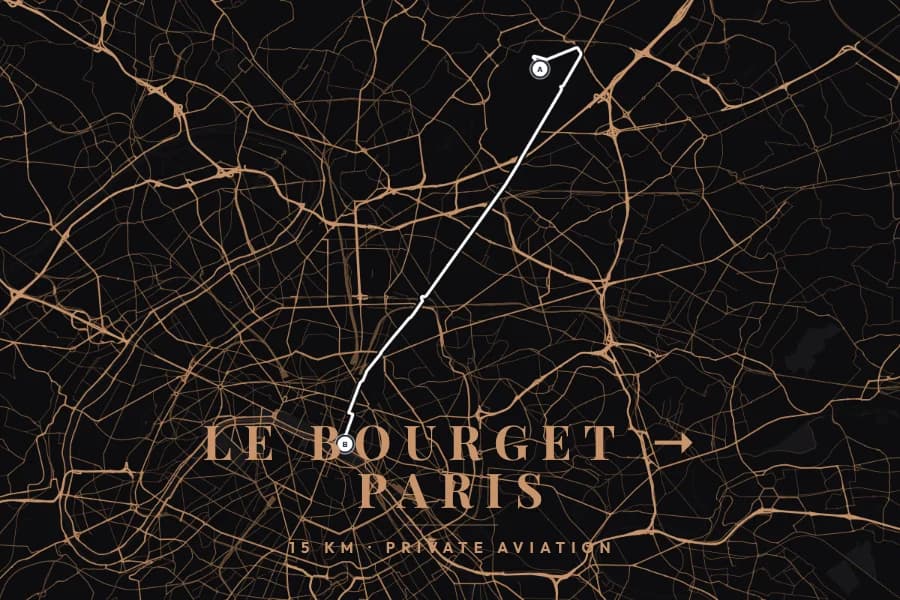
Le Bourget sits 15 kilometers northeast of central Paris. In good traffic, the drive to the 8th arrondissement (Champs-Élysées, major hotels) takes 25 to 30 minutes. In rush hour, allow 45 to 50 minutes.
Key routes:
- To the 8th/16th (Right Bank, hotels, corporate offices): A1 south to Porte de la Chapelle, then périphérique west.
- To La Défense: A86 west, typically 25 to 35 minutes.
- To the 6th/7th (Left Bank, Saint-Germain): A1 south, Porte d’Orléans or Quai de Bercy. Allow 35 to 45 minutes.
- To Versailles: A86 then A13. Approximately 45 to 60 minutes.
The Paris Air Show Factor
Every two years in June (next edition: 2027), the Paris Air Show transforms Le Bourget. During the show week, business aviation movements are restricted or relocated. If you’re planning private aviation travel to Paris during Air Show week, expect adjusted FBO procedures and increased road traffic around the airport perimeter.
What Your Assistant Should Know
For executive assistants arranging Le Bourget transfers, the checklist:
- Confirm the FBO with the charter operator. Don’t assume.
- Share the tail number with the chauffeur service. This is how they track your aircraft.
- Specify the terminal or handler in the booking notes. “Le Bourget” alone is not precise enough.
- Book the return 90 minutes before slot time for central Paris pickups. This builds in traffic contingency without requiring the passenger to wait at the airport.
- Request the driver’s mobile number in advance. At Le Bourget, communication between driver and passenger is direct, not mediated by an app.
Why the Chauffeur Decision Matters More at Le Bourget
At CDG or Orly, a chauffeur meets you in the arrivals hall. The margin for error is wide, you can wait five minutes and nothing is lost. At Le Bourget, the margin is different. The aircraft is on the apron for a limited time. The FBO has multiple access points. The client may be met on the tarmac or in a private lounge. The chauffeur needs to know which one, and they need to be in the right place when the aircraft door opens.
This is not a criticism of general car services. It is an observation that Le Bourget requires a specific kind of knowledge that most Paris transport providers don’t have, because most of them have never been airside at Le Bourget. PrivateDrive chauffeurs handle Le Bourget transfers regularly and coordinate directly with FBO handling agents.
Le Bourget is fifteen kilometers from central Paris. But in operational terms, it is a different world from CDG, more private, more precise, and more demanding of the ground transport that connects it to the city. Getting it right means a smooth door-to-door experience. Getting it wrong means standing on the wrong side of a perimeter fence watching your luggage go the other way.
Le Bourget private transfer from €110. FBO coordination included.