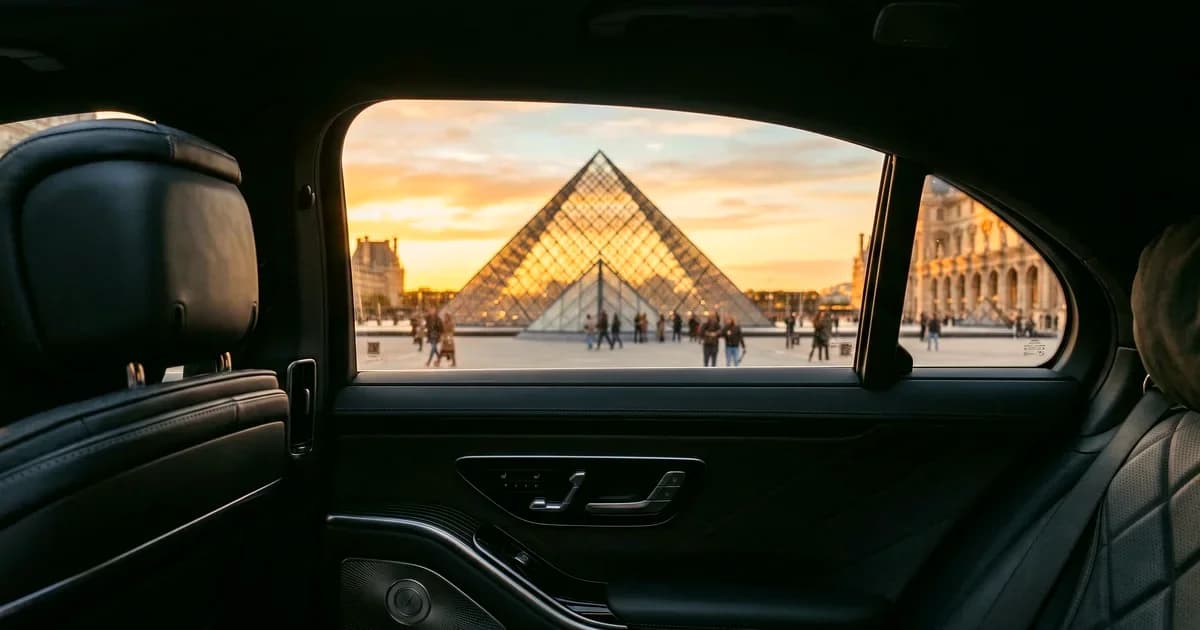
Between nine in the morning and half past six in the evening, Paris will let you walk from the Code of Hammurabi to the Gates of Hell. No other city offers the equivalent: the Louvre for everything painting and sculpture did before 1850, the Musée d’Orsay for the sixty years in which the French reinvented both, the Musée Rodin for a garden where sculpture stopped living indoors. Three museums, three temperaments, one day.
The obstacle has never been the art. It is the connective tissue: Louvre to Orsay to Rodin means three kilometres of kerbs, bridges and security lines, and the Métro joins them only grudgingly, with a change and a walk at every end. A private car compresses the whole chain into roughly twenty-five minutes of movement. What follows is the Paris museum tour as our chauffeurs actually drive it, rebuilt for 2026, a year in which the rules changed faster than in the previous decade.
Three Museums, Three Temperaments
The Louvre, on the condition that you choose
The numbers are famous and almost beside the point: 8.7 million visitors in 2024, some 35,000 works on display, a palace so vast the museum publishes suggested routes the way an airline publishes timetables. The only strategy that survives contact with the building is to pick one wing and defend the choice. First visit: the Denon Wing. The Winged Victory on the Daru staircase, the Grand Gallery of Italian painting, and the Salle des États, where the Mona Lisa lives behind her rail (the Venus de Milo is a short detour into the neighbouring Sully wing). Returning visitors do better in Richelieu: the sculpture courtyards under their glass roofs, Vermeer and Rembrandt upstairs, and the apartments of Napoleon III, the most theatrical rooms in Paris.
Two things are new this summer. The Galerie d’Apollon, scene of the October 2025 theft of the crown jewels, reopened on 22 July 2026 after nine months behind closed doors; the display cases are gone, and the gallery is finally shown for what it is, Le Brun’s ceiling and the room itself. And the museum has formally entered its Nouvelle Renaissance decade: a new entrance through the eastern Colonnade and a dedicated room for the Mona Lisa are promised by 2031, which means the internal circulation will keep shifting for years. Rooms you saw on a previous trip will not necessarily be where you left them.
The Orsay, a railway station at the height of its powers
The building was a terminus, built for the 1900 Exposition Universelle, saved from demolition, opened as a museum in December 1986; it turns forty this December, and the anniversary programme will thicken the crowds. Inside is the densest great collection in Europe, 1848 to 1914: Monet’s cathedrals, Renoir’s dance halls, Degas’s dancers, Van Gogh’s bedroom, Cézanne’s card players. The visit has a correct order. Upper level first, while attention is fresh, then the ground-floor sculpture aisle on the way out; the middle level is where momentum goes to die. Two to two and a half hours, and note the Thursday nocturne, open until 21:45 with a reduced ticket after 18:00.
The Rodin, where sculpture went outdoors
The Hôtel Biron is the intimate act of the day. Rodin worked in this eighteenth-century mansion from 1908 until his death in 1917, and left the state everything in it on the condition that the house become his museum. The Thinker, the Burghers of Calais and the Gates of Hell stand in three hectares of garden with the dome of the Invalides above the wall; The Kiss holds the ground floor; upstairs hang paintings Rodin owned himself, including Van Gogh’s portrait of his paint dealer, Père Tanguy. Ninety minutes covers it. Two hours lets the garden do what it does at the end of an afternoon.
Tickets in 2026: New Prices, Stricter Rules
Booking discipline used to be advice. It is now the admission system itself. The Louvre requires a timed reservation from every visitor, released 60 days ahead, and since 14 January 2026 it charges by geography: €22 for visitors from the European Economic Area, €32 for everyone else, a 45 percent rise aimed squarely at the museum’s international majority. The Orsay followed in March, and a timed slot is now mandatory there too: €16 at full rate, €12 on Thursday evenings. The Rodin stays at €14, garden included, and remains the one door where a same-day ticket is a realistic hope.
The efficient play for the triple: book the Louvre at opening, the Orsay for early afternoon, and take the combined Orsay-Rodin ticket at €25, which spares one queue and about five euros. A non-EEA adult clears the whole day for €57 in entries; an EEA passport brings it to €47. Then respect the calendar trap. The Louvre closes on Tuesdays, the Orsay and the Rodin on Mondays, so the full three-museum day exists only Wednesday through Sunday. A Monday in Paris is a Louvre day; a Tuesday belongs to the other two.
The Full Day, Hour by Hour
| Time | Where | What happens |
|---|---|---|
| 09:00 | Hotel to the Louvre | Drop-off on Rue de Rivoli; doors at opening, one wing, three hours |
| 12:20 | Louvre to the Orsay | Eight minutes across the Seine; bags stay in the car |
| 12:30 | Lunch | Café Campana behind the great clock, or the 1900 dining room of Le Restaurant, booked ahead |
| 13:30 | The Orsay | Upper level first, sculpture aisle on the way out |
| 16:10 | Orsay to the Rodin | Five minutes into the 7th arrondissement |
| 16:20 | The Rodin | The house, then the garden in the best light of the day |
| 18:30 | Onward | Back to the hotel, or straight to an early dinner |
Lunch is the one decision worth taking seriously in advance. Café Campana, up among the Impressionists, keeps the break under an hour; the former station’s gilded 1900 dining room is the spectacular option and books out. Serious eaters sometimes invert the logic entirely and build the afternoon around a starred table instead, trimming the Orsay to its upper level.
Pacing matters more than coverage. Three museums produce roughly seven hours of looking, which is the honest ceiling for anyone whose profession is not art history. The half hour of car time that stitches the day together is not dead time; it is where coffee happens, feet recover and the next building gets decided. Museum fatigue is a logistics problem before it is a stamina problem, and the logistics are solvable.
Two Shorter Cuts, Including the Thursday Inversion
The half-day version keeps the hierarchy: three hours in one Louvre wing, ninety minutes on the Orsay’s upper level, finished by 14:00 with the afternoon returned to the rest of your Paris list. It suits first visits grafted onto working trips.
Thursday allows a better trick. Run the day backwards: the Rodin at 10:00 when the garden is at its quietest, the Louvre after lunch, then the Orsay from 18:00 at the €12 evening rate, under a glass roof that turns amber as the sun drops, until 21:45 if you last that long. At that hour the museum holds a fraction of its daytime crowd. Afterwards the car is already waiting, and the evening can simply continue: Paris after dark runs to its own itinerary.
Returning visitors with both Louvre wings behind them have a third option: keep the Orsay-Rodin afternoon and spend the morning out of the city at Chantilly, where the Condé collection is the strongest gathering of old-master painting in France after the Louvre itself, forty minutes north by car.
What the Car Actually Solves
Start with the bags. All three museums restrict what enters the galleries, and cabin-size luggage is refused outright, which on a checkout day turns a cultural itinerary into a hunt for lockers. The car is the cloakroom: suitcases, shopping, coats and umbrellas ride along, ten metres from wherever you happen to be standing.
Then the traffic rules. Central Paris has run a limited-traffic zone since late 2024: through traffic is banned in the heart of the city, and the Louvre sits inside the perimeter. A professional driver carrying passengers to an address within the zone is exactly the traffic the scheme permits, so the Rivoli drop-off works in 2026 the way it always has, while the visitor at the wheel of a rental inherits the parking question the zone was designed to discourage. Between drop-offs the driver loops or waits outside the perimeter; there is no parking in your day because there is no parking at all.
Weather is the third solve. The Rodin is the exposed leg, and a good driver reads the sky before you do. The classic wet swap is the Orangerie, five minutes away in the Tuileries, where Monet’s water lilies wrap two oval rooms; if those rooms convert you, the gardens at Giverny where he painted them are an hour from your hotel on another day. And the schedule itself stays soft: timed tickets fix when each visit begins, never when it ends. If Cézanne claims an extra half hour, the only thing that moves is the car.
There is a ride-hailing version of this day: four separate bookings, four waits at the kerb, and pricing that answers to demand precisely when every museum empties at closing time. It works, roughly, the way scaffolding works as architecture. The chartered version runs from €85/h with an E-Class and a driver who has done the circuit often enough to know which door of the Orsay actually moves at 13:30. Across a nine-hour day the difference is not comfort; it is that the seven hours of looking arrive intact.
And 2026 argues for doing it now rather than perfectly. The Galerie d’Apollon is open again, the Orsay turns forty in December, and the Louvre is entering a decade of works that will move famous rooms more than once before the new Colonnade entrance opens. The collections are not going anywhere. The buildings, for once, are. Charter the museum day by the hour, or set it as the cultural spine of a full 72-hour Paris itinerary.