Key takeaway
A chauffeur-driven Paris evening after dark: Eiffel sparkle timing, Pont Alexandre III, Vendôme, Montmartre and Notre-Dame, with 2026 timings and costs.
Most visitors meet Paris in daylight and in queues. The Louvre at eleven, the Eiffel Tower from the back of a line, Versailles on a Tuesday. None of it is wrong. It is simply the version of the city that everyone else is seeing too, at the same hour, from the same spot.
After dark the city changes register. The monuments light from within, the Seine doubles every facade it touches, and the tour groups thin until the streets belong to the people who live on them. The Eiffel Tower breaks into five minutes of light on the hour. Notre-Dame stands floodlit and reflected on the Île de la Cité, back in service after the fire. The place stops behaving like a museum and starts behaving like a city.
What a private car changes is not the monuments but the connective tissue between them. No taxi rank at midnight, no metro map, no walking the long way because the river is in the way. You move from one lit scene to the next on your own clock, with a driver who knows which end of which bridge holds the view. For anyone fitting the evening into a longer stay, it reads as one chapter of a 72-hour Paris itinerary rather than a one-off. Here is the evening that works, and the timing that makes it.
Start at the blue hour, not before
The good evening begins at the blue hour, around half past eight in late spring and summer, closer to seven once autumn shortens the days. You want to reach the first monument as dusk turns the sky that brief cobalt and the gold lighting flicks on against it. Arrive too early and you get the worst of both: flat afternoon glare, tour groups still moving, the lights not yet earning their effect.
The Eiffel Tower sets the clock. Its golden lighting comes on by itself at nightfall, and on the hour, for five minutes, twenty thousand bulbs flicker across the iron. One detail most itineraries get wrong: the sparkle runs on the hour only until eleven at night, even though the steady gold holds until one in the morning through the summer. Build the evening around catching a sparkle before eleven rather than after, because past eleven the show is the calm gold, not the flash.
By day Paris pushes you outward, to Versailles and the great day trips out of the city. The evening is the opposite invitation: stay inside Paris and let it perform. The sparkle is best watched from a slight distance rather than from underneath, at Trocadéro, on the Pont d'Iéna, or from the lawns of the Champ de Mars. A driver can time the approach so you are in place a few minutes before the hour instead of watching it shrink through a windscreen.
Trocadéro, the river, and the order of the first hour
Begin at Place du Trocadéro, the raised terrace on the Right Bank that gives the cleanest frontal view of the tower across the water. The symmetry of the Palais de Chaillot framing the iron is the photograph everyone half-remembers, and at night, lit gold, it earns the cliche. Watch the nine o'clock sparkle from the esplanade, then walk down to the Pont d'Iéna for the same tower at closer range over the Seine.
Cross to the Left Bank and give the Champ de Mars ten minutes. This is where Parisians actually sit on warm evenings, bottles open on the grass, the tower above them rather than in front of them. Lower, quieter, more intimate than Trocadéro, a different reading of the same monument.
The order matters more than the list. Trocadéro for the frontal shot, the bridge for the water, the lawn for the human scale: three takes on one tower inside twenty minutes, exactly the sequencing that falls apart the moment you try to improvise it on foot between metro stops.
The bridge, the gold dome, and the great empty square
Pont Alexandre III is the most theatrical of the bridges across the Seine. Built for the Universal Exhibition of 1900, it carries gilded cherubs, winged horses and bronze lamp standards that all light after dark, and from its deck the view back toward the Invalides or on toward the Grand Palais is Paris at its most deliberately beautiful. It is a strong dinner address as well, with several celebrated tables a few minutes away.
A short run east brings the Hôtel des Invalides, Napoleon's tomb under a dome that turns gold at night, its esplanade usually empty of the daytime crowd. Then Place de la Concorde: the obelisk, the two lit fountains, the Tuileries running east and the Champs-Élysées climbing west, one square that quietly tells you Paris was laid out at a scale most cities never attempted.
Continue up the Champs-Élysées to the Arc de Triomphe and let the driver take the roundabout once. The twelve avenues converging in light on the Arc only resolve from the road, turning with the traffic, which is a thing no pavement gives you and no daytime drive enjoys.
Where the city goes quiet: Vendôme, the Opéra, the Butte
Place Vendôme at half past ten is one of the surprises of the Paris night. The Ritz, the Cartier flagship, the column at the centre, all lit and almost entirely deserted in a way that is impossible to picture by day. A five-minute stop becomes fifteen once you are standing in the empty square.
The Palais Garnier is lit in full Second Empire excess, and the Grands Boulevards around it keep a late energy the monument circuit otherwise lacks. Then up the Butte to Sacré-Cœur, white against the sky and visible across the north of the city, where the climb the driver knows ends at one of the great Paris panoramas: the grid falling away south, the Eiffel Tower six kilometres off. After dark Montmartre returns to itself, the souvenir shops shut, Place du Tertre emptied of its day painters.
At the foot of the hill the Moulin Rouge turns again. Its red sails came down one night in 2024 and went still for more than a year; they were restored and turning once more by the summer of 2025, the kind of detail a Parisian notices and a guidebook misses. The show runs from around €97, more with a champagne table, if the evening calls for it.
Dinner is what turns an itinerary into an evening
An evening of monuments without a table is a tour. With one, it becomes the night out it was meant to be. The route is dense with options, and the real choice is where in the evening the hunger lands.
For the tower in the window there is the rooftop above the Quai Branly, the dining room on the tower's own first floor, or the top-end address at the Peninsula. Around the Opéra the grand brasseries run late and keep their terraces on the square. The same driver who handles a Michelin evening across several addresses runs the simpler version here: held at the kerb through dinner, so the car is waiting when you step out rather than a problem to solve at eleven at night.
If the night is built around the river itself, the dinner cruises board near the tower and run roughly two hours past the central monuments, from about €75 to well over €200 for the assigned-table version. The driver sets you down at the pier and is there at the gangway on the way back, the whole difference between a romantic idea and a wet wait for a taxi.
Notre-Dame at midnight, and the city with its monument back
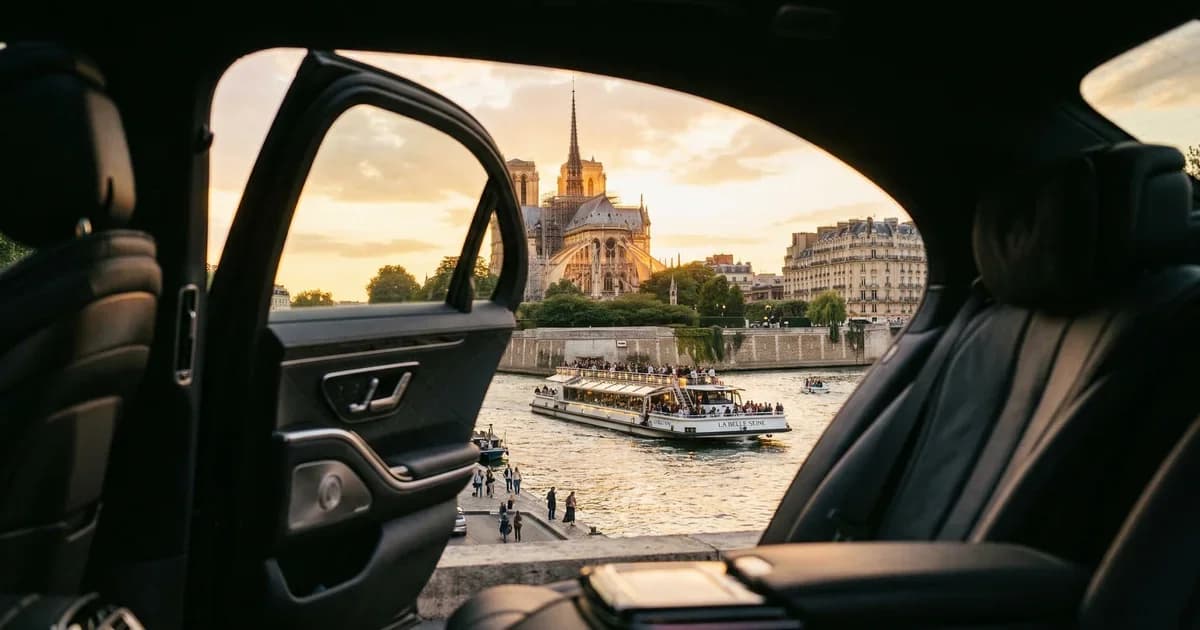
The cathedral has been the quiet headline of the Paris night since it reopened in December 2024, five years after the fire. The restored facade is floodlit from below, and to stand on the Île de la Cité near midnight with the towers doubled in the Seine is one of the few sights in Paris that feels genuinely of its moment: a monument returned rather than merely old.
There is a practical wrinkle worth knowing. The exterior is yours at any hour, but the interior keeps its own clock, open late only on Thursdays, until ten at night, when the nave is lit and far quieter than the daytime queues allow. The bell towers reopened in September 2025. For most evening circuits the cathedral is the closing exterior, the last lit thing before the drive home, and it holds that place better than anything else in the city.
What the evening costs, and what the car is really for
A private evening tour is booked as time, not distance. A three-hour circuit through the lit monuments starts from €255 in a Mercedes E-Class and €300 in a V-Class for a family or a group travelling together of up to seven, with a small premium once the clock passes nine, since that is when the night rate begins. Add dinner along the way and the evening stretches to four or five hours, €340 to €425 in an E-Class, the driver holding the car through the meal rather than leaving you to the taxi lottery afterwards.
It is the same fixed-fare logic as an airport transfer, settled before the wheels turn rather than counted against the traffic. The figure is per car and agreed at booking, which on an evening that crosses the night-rate line and several arrondissements is worth more than it first looks.
Against the alternative the maths is plain. A hop-on coach is cheaper per head and runs to its own timetable and its own forty strangers. The private evening costs more in money and almost always less in everything else: the pace, the order, the freedom to give Vendôme fifteen minutes and the Arc a single turn of the roundabout.
Paris at night is not a second city bolted onto the first. It is the same streets at a different setting, the crowds gone, the light changed, the pace finally yours to set. The monuments do the work they always do. What shifts is your ability to move between them without friction, the one thing the daytime version never quite grants. A driver does not improve the view; he removes what stands between you and it, and on a Paris evening that turns out to be most of the trouble.
Plan your Paris evening with PrivateDrive. As-directed evening circuits, a driver who knows the viewpoints and the timing, dinner and cruise coordination, and a fixed price agreed before you leave.
Related Destinations
Related Articles
Paris Shopping Day: Private Driver, Le Marais to Montaigne
lifestyle-luxeThe Art of Arriving in Paris: Your Transfer Sets the Tone
lifestyle-luxeLuxury Hotel Transfer Paris: Palace Standards in 2026
market-intelligenceParis VTC Market 2026: Prices, Trends & Real Data
excursions-destinationsGiverny by Private Car from Paris: The 2026 Day Trip Guide
lifestyle-luxeParis Morning Tour: Montmartre, Marais & Saint-Germain
Also on this topic:Auvers-sur-Oise Day Trip: Timing Van Gogh's Village, 72-Hour Paris Itinerary by Private Chauffeur, Michelin Restaurant Paris by Private Driver: 2026 Guide.