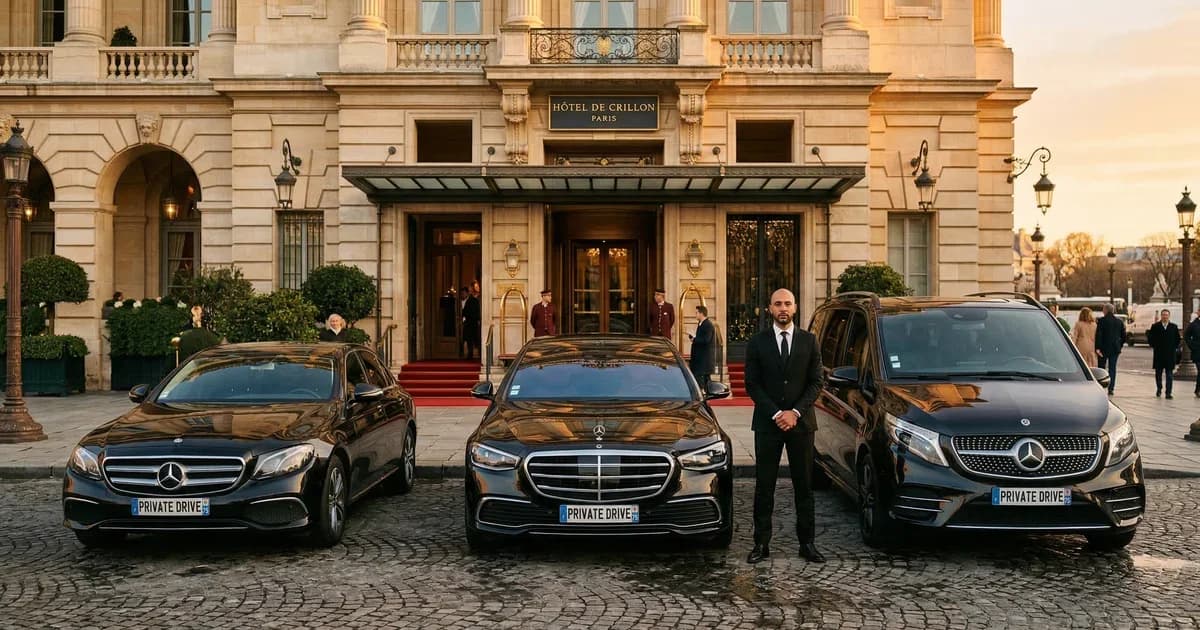
France welcomed a record 102 million international visitors in 2025, and Paris Aéroport moved 106.96 million passengers through Roissy and Orly, up 3.4 percent on the year. Those are the headline numbers, and for anyone arranging premium ground transport they are also a little misleading. A city does not fill evenly. Paris runs hot in bursts, weeks when the palace hotels sell out, when the ring road thickens by mid-afternoon, and when demand for an experienced chauffeur in an S-Class can run two to three times what it is in a quiet stretch of February. These are the peak travel weeks, and in Paris they are surprisingly few.
The useful intelligence is not that the city is busy. It is knowing which weeks are merely crowded and which ones actually move the premium market, because the two rarely line up. A packed July Saturday on the Champs-Élysées and a Tuesday in late September during the women's shows are both busy. Only one of them empties the city of available cars.
Paris Runs on Peaks, Not Averages
Tourism here sorts into four seasons, each with its own demand signature. The spring quality peak, mid-April to mid-June, stacks the Easter, Ascension and Pentecost holidays against the year's best weather odds and the city at its most photogenic. CDG passenger volumes in May and June rank among the highest of the year, and leisure and corporate travel overlap before the summer break.
Summer is the volume peak, July into mid-August, and it splits in a way that matters. July is dense with tourists. August keeps visitor numbers high while Parisians leave for their own holidays, which hollows out the residential city and shifts where cars are actually needed. The operational side of that shift is the subject of our guide to what changes for airport transfers in July and August; the demand itself stays strong even as the streets feel emptier.
Autumn is the premium window. From the end of September the women's ready-to-wear shows, the trade-fair calendar and conference season converge, and September and October become the most important months of the year for business travel and high-end transport. December closes the year on a distinct leisure-luxury peak: Christmas week and New Year's Eve, booked months ahead by international visitors who want palace hotels, Michelin tables and a car waiting after the fireworks.
The Ten Weeks That Move Premium Demand
Cross-referencing air-passenger volumes, hotel occupancy, the major-event calendar and corporate travel patterns, a consistent top ten emerges. These are the weeks when booking a specific vehicle class with an English-speaking driver becomes genuinely competitive rather than routine.
| Rank | Period | What drives it | Premium demand |
|---|---|---|---|
| 1 | New Year's Eve and Christmas week (Dec) | International celebrations, palace-hotel leisure, CDG December peak | Extremely high |
| 2 | Paris Fashion Weeks (Mar and Sep to Oct) | Fashion houses, international press and buyers | Extremely high |
| 3 | Autumn trade-show and conference run (Sep to Nov) | Corporate roadshows, VivaTech, SIAL, OECD-type forums | Very high |
| 4 | Easter weekend (Apr) | Pan-European leisure travel | Very high |
| 5 | Bastille Day weekend (mid-Jul) | Tourism density peak | Very high |
| 6 | Late-May bank holidays (Ascension, Pentecost) | Multi-day breaks, domestic and EU visitors | High |
| 7 | Cannes Film Festival weeks (May) | Secondary Paris demand on the travel chain | High |
| 8 | Roland-Garros fortnight (late May to Jun) | International sport, corporate hospitality | High |
| 9 | All Saints' break (early Nov, Toussaint) | French school holiday, family travel | High |
| 10 | Paris Air Show (Jun, odd years only) | Aerospace and corporate aviation | Very high in cycle years |
One row carries a 2026 caveat the generic calendars miss. The Paris Air Show at Le Bourget is biennial and runs only in odd years, so there is no 2026 edition; it returns 14 to 20 June 2027. In the off year that aerospace-driven June spike simply is not there, which is exactly the sort of detail that separates a real demand calendar from a recycled one. How VivaTech in June and the SIAL food show in October fill the corporate gap is laid out in our breakdown of Paris trade-show transport.
Why Composition Beats Volume
A week can be crowded without being a premium-demand week. What decides the difference is who is arriving, not how many.
Fashion Week is the clearest case. The September to October women's edition runs 28 September to 6 October in 2026, nine days that concentrate exactly the clientele private chauffeur services are built for: house executives, international buyers, editors, celebrities and the teams around them. The density of morning show-to-show runs, late after-party extractions and airport connections inside a compressed window makes it one of the single highest-demand periods in the Paris luxury calendar, well above what its raw visitor count would suggest.
Corporate conference season, roughly September to November, draws the steadier line. Overlapping international conferences, roadshows and board cycles keep premium airport-transfer demand elevated for weeks rather than days, which is why companies that move people through Paris regularly tend to formalise the arrangement; the mechanics of that sit in our guide to setting up a corporate ground transport account. New Year and Christmas pull the third profile, couples and families at the top of the leisure market, where demand turns on a specific night and a specific car rather than on sheer numbers.
The Airport Is Where the Peak Lands First
Every peak week shows up at the airport before it shows up anywhere else. CDG handled 72.03 million passengers in 2025 and Orly 34.93 million, while Le Bourget remains the pressure point for private aviation. Transfer demand spikes on the shoulders of each peak: the Friday before Fashion Week and the Sunday after are reliably the two most congested transfer windows of their season, and the same shape repeats around every major trade show. The structural version of this story, how rising passenger volumes are reshaping the whole sector, runs through our analysis of how 107 million airport passengers are reshaping Paris ground transport. The practical takeaway is narrower: build wider arrival and departure buffers into any trip that lands on a peak week, because the road in from Roissy will not cooperate.
What 2026 Adds to the Curve
Several 2026-specific factors bend the normal seasonal shape. The European Entry/Exit System went fully live on 10 April 2026, replacing passport stamps with biometric checks at the border for non-EU arrivals, and ETIAS, the travel authorisation for visa-exempt nationals, is expected to follow in the final quarter of the year before becoming mandatory around spring 2027. Both add friction at the front door, and friction tends to concentrate bookings into earlier, better-planned windows rather than spreading them across the calendar.
The rest of the 2026 picture is capacity catching up with demand. Grand Paris Express line openings are gradually redrawing suburban transfer patterns, post-Olympic event and MICE traffic has settled into a steady corporate baseline rather than a one-off surge, and the premium fleet has largely electrified ahead of the regulatory schedule. For a traveller, the net effect is a market that stays tight at the top during peak weeks even as the city's overall capacity grows.
Reading the Calendar as a Traveller
The intelligence converts into three practical moves. First, book ground transport early for the genuine peaks. Premium supply during Fashion Weeks, Christmas and New Year, and major trade-show weeks is finite, and trying to secure an S-Class with a seasoned English-speaking driver forty-eight hours before one of those events usually ends in a compromise or a surcharge.
Second, treat CDG and Le Bourget as the timing risk, not the city centre. The congestion that wrecks schedules clusters at the airport shoulders, so the buffer belongs at the start and end of the trip. Third, for anything spanning a full peak event, a pre-arranged package across the whole stay beats booking transfers one at a time. It locks vehicle availability, fixes the price before demand pricing engages, and lets a single driver learn the rhythm of the schedule. Our 2026 luxury ground transport market study tracks how this advance-booking habit has hardened at the premium end as the platform tiers grow less reliable in exactly these windows.
The Market Behind the Calendar
Read together, the data describes a city in sustained high demand with its capacity slowly expanding underneath it. For the premium traveller that combination is less a problem to manage than a calendar to read. The scarcity in Paris is never the city itself; it is experienced drivers and the right vehicle, concentrated into roughly ten weeks a year, against clients who all want the same evening. Knowing which weeks those are, and committing to them early, is most of the advantage. Across the rest of the year Paris will hold a car for you on a day's notice. During the ten that count, the calendar is the booking.
Plan your peak-week transport with PrivateDrive. Fixed pricing locked at booking, English-speaking chauffeurs, and guaranteed vehicle availability across Fashion Week, the autumn trade-show season and the December holidays for clients who book ahead.