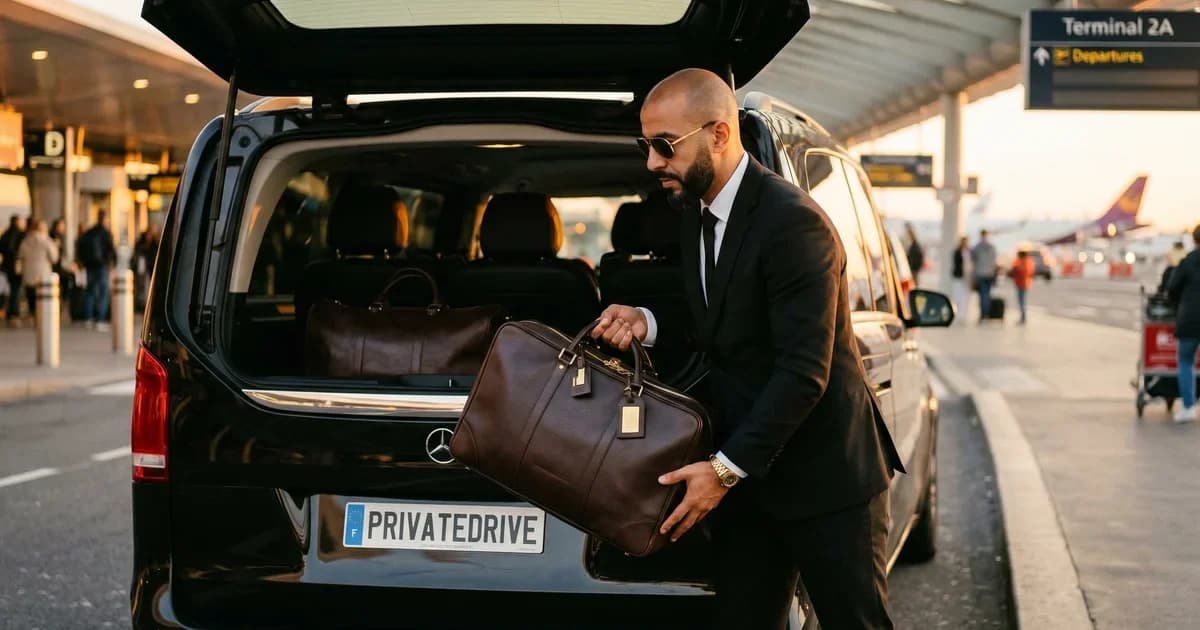
Every summer the same scene repeats itself at Charles de Gaulle and Orly. The taxi rank backs up past the forty minute mark, ride hailing apps quietly double their fares through the evening, and somewhere in Terminal 2E a business traveller watches a connection slip away that would have been routine in March. None of it is bad luck. It is the predictable shape of a Paris summer airport transfer, and most of it can be designed out before the trip begins.
July and August are not simply a busier version of the rest of the year at CDG. They are a different operating environment, with different bottlenecks, different timings and a different margin for error. The traveller who treats an August Friday like an ordinary Tuesday is the one who ends up sprinting through a terminal. Knowing precisely what changes, and where the new friction sits in 2026, is what separates a calm arrival from a scramble.
This year the picture has shifted again. Passenger volumes are forecast to break pre-pandemic records, the European border system that went live in April has added a biometric step to every non-EU arrival, and the summer strike calendar has already opened. Three forces, stacked on the same weeks. Here is how each one lands on the ground, and what it changes for getting to and from the airport.
The Border Became the Bottleneck
The single largest change to a Paris summer airport transfer in 2026 happens before you reach the car. The European Union's Entry/Exit System went fully operational across all twenty nine Schengen countries on 10 April 2026. Every non-EU, non-Schengen traveller is now registered biometrically on first entry, a facial image and four fingerprints, a capture that runs thirty to ninety seconds per person. Multiply that across a long haul arrival bank at Terminal 2E and the arithmetic turns hostile fast.
The early results are blunt. Since the April switch, French airports have recorded sixty to one hundred and twenty minute waits at peak, and the non-EU lines at CDG Terminal 2E have stretched close to two hours when several wide bodies land together. Paris Aéroport pushed back hard enough that CDG and Orly formally asked the European Commission to postpone the final, all-passenger activation until after the summer peak, warning of congestion the terminals cannot physically absorb. Whatever Brussels decides, the planning assumption for July and August is simple: border control is now the slowest part of the arrival, not the road. That same reality reshaped the ordinary CDG morning, as the business traveller's Monday morning CDG guide sets out in detail.
Record Volume on a Slower Frontier
The border slowed down in the same year the crowd got bigger. CDG handled 72.03 million passengers in 2025 and Orly almost 35 million, and the 2026 summer is projected to beat pre-Covid highs as long haul demand returns in full. More arrivals feeding a longer biometric queue is not an additive problem, it compounds. Our analysis of how 107 million airport passengers are reshaping Paris ground transport traces where that pressure goes once travellers clear the hall.
For the transfer itself the consequence is a number. Build sixty to ninety minutes of buffer into any inbound plan in July and August, measured from wheels down, not from the scheduled landing. A driver who tracks the flight in real time and absorbs that variance without charging for it is no longer a refinement. It is the mechanism that makes the buffer free rather than expensive.
Strike Season Sits Inside Peak Season
French summers carry a second, less predictable variable: industrial action. It tends to cluster in June and July, precisely as volumes climb. The 2026 calendar opened with a twenty four hour ground staff strike called for 18 June across CDG, Orly and Le Bourget by an intersyndicale of CGT, CFDT, UNSA and Sud Aérien, over the tightening of the security badge rules that govern access to restricted zones. Baggage handlers, ramp agents, check in and cleaning crews all fall within scope, and comparable strike days have cut scheduled capacity at the two main airports by as much as forty percent.
A walkout of that kind does not stop a private car, but it reshapes everything around it: slower bag delivery, longer turnarounds, last minute consolidations and cancellations that ripple through the day. The defence is the same one that works against the border and the crowd. Lock the ground leg to a fixed, monitored arrangement, so that when the airport wobbles the one part you control stays still.
The Taxi Rank and the Surge, Measured
Paris draws well over forty seven million visitors a year, the densest share of them in summer, and tourist demand collides with business travel and Schengen transit at exactly the hours supply is thinnest. The rank and the apps both feel it.
- Taxi queues at CDG regularly run thirty five to forty five minutes through the morning and mid afternoon arrival waves.
- Ride hailing surge on the apps routinely reaches two to two and a half times base on summer evenings, and triples on a strike morning.
- The regulated taxi flat fare holds at 56 € to the Right Bank and 65 € to the Left Bank, genuinely hard to beat for a solo traveller on a calm day.
- A booked private transfer sits at €150 fixed from CDG to central Paris, the price written before you fly and unmoved by the date, with the flight tracked and an hour of waiting included.
The honest framing is not that one option wins everywhere. It is that the gap between a queued taxi and a pre booked car is measured in thirty to forty five minutes and a known price, and in summer both of those grow. Our 2026 guide to what you should actually pay lays the full grid out, surcharges and all.
Departures: The City Leaves at Once
Arrivals get the attention, but the harder summer problem is often the departure. French school holidays run from early July to the start of September, and they turn every Friday afternoon and Sunday evening into a synchronised exodus. The périphérique and the A1 to CDG thicken into stop and start, and the airport you reach is itself slower inside.
| Factor | Off-peak | July and August peak |
|---|---|---|
| Paris to CDG drive | 40 to 50 min | 60 to 90 min |
| Security wait at CDG | 10 to 20 min | 30 to 60 min |
| Non-EU border with EES | 20 to 40 min | up to 120 min |
| Recommended arrival buffer | 2.5 hours | 3.5 to 4 hours |
A chauffeur routing in real time can still shave fifteen to twenty minutes off the road by reading the A1 and the périphérique before they seize. The larger gain is mental: a departure that starts on a confirmed pickup, the timing already adjusted for the day, removes the first and worst decision of a stressful morning.
Orly and CDG Diverge in July
The two airports do not surge the same way. Orly is mostly domestic and medium haul European traffic, and its summer pressure is real but more contained: in the 2024 peak, the large majority of international arrivals still cleared the border inside ten minutes, and the A6 and A10 approaches generally move better than the A1. Charles de Gaulle is the long haul hub, three terminals across a campus the size of a small town, and its Terminal 2E carries the heaviest border queues of any gateway in the country. A driver who knows which terminal, which level and which meeting point applies is worth more in August than in any other month, because the wrong guess is a ten minute walk with luggage in the heat. The full Orly picture, RER and tram included, sits in our Orly to city centre comparison.
What Booking Ahead Actually Removes
A pre arranged transfer does not make the airport faster. It removes the parts of the day that are yours to lose. The flight is linked to the booking, so a late inbound moves the pickup automatically and the waiting time, up to an hour after landing, is not billed against you. The meeting point is fixed by terminal rather than improvised at a kerb. The price is locked when you book and the summer rate is shown before you pay (+10% from June to September): on a peak August evening that is still the difference between a fixed fare and an app fare that can surge by half. For a family with luggage or a group splitting across two cars that predictability is the whole point, and the cost of getting it wrong in summer is steep, as the breakdown of the hidden cost of unreliable transport makes plain. The one operational habit that matters most: book at least seventy two hours ahead through July and August, and earlier still around the 14 July and 15 August holidays, when same day availability simply runs out.
Summer in Paris rewards the traveller who treats the airport leg as part of the itinerary rather than an afterthought. The border will be slow, the crowd will be record breaking, and a strike may land on the worst possible morning. None of that is within your control. The transfer is. Fix the price, link the flight and name the driver before you leave home, and the one variable you can remove stays removed, on the day it matters most.
Book your Paris summer airport transfer with PrivateDrive. Fixed pricing from €150 for CDG and €120 for Orly, real time flight tracking, an hour of complimentary waiting, a named driver with a board in arrivals, and a Mercedes E-Class, S-Class and V-Class fleet for families and groups.