Key takeaway
Traveling to Paris with kids in 2026? French car seat law, taxi versus VTC, CDG terminals, and why a booked private car beats the RER with a pushchair.
You land at Charles de Gaulle at half past seven in the morning, nine hours in the air behind you and none of them spent asleep. There is a five-year-old who wants to run and an eighteen-month-old who wants to be carried. Four bags. A folded pushchair. Somewhere in the luggage, a car seat you packed without being sure you still needed it. The arrivals hall is loud, the signage is French, and the taxi queue outside is already forty deep.
This first hour, the hop from the terminal to the city, is the part of a Paris family trip that most reliably goes wrong. It is also the part that responds best to a single decision made a week earlier. Get that decision right and the airport becomes a ten minute walk to a waiting car with the seats already fitted. Get it wrong and it becomes the story you tell about how the holiday started badly.
The One Rule That Separates a Taxi from a Private Car
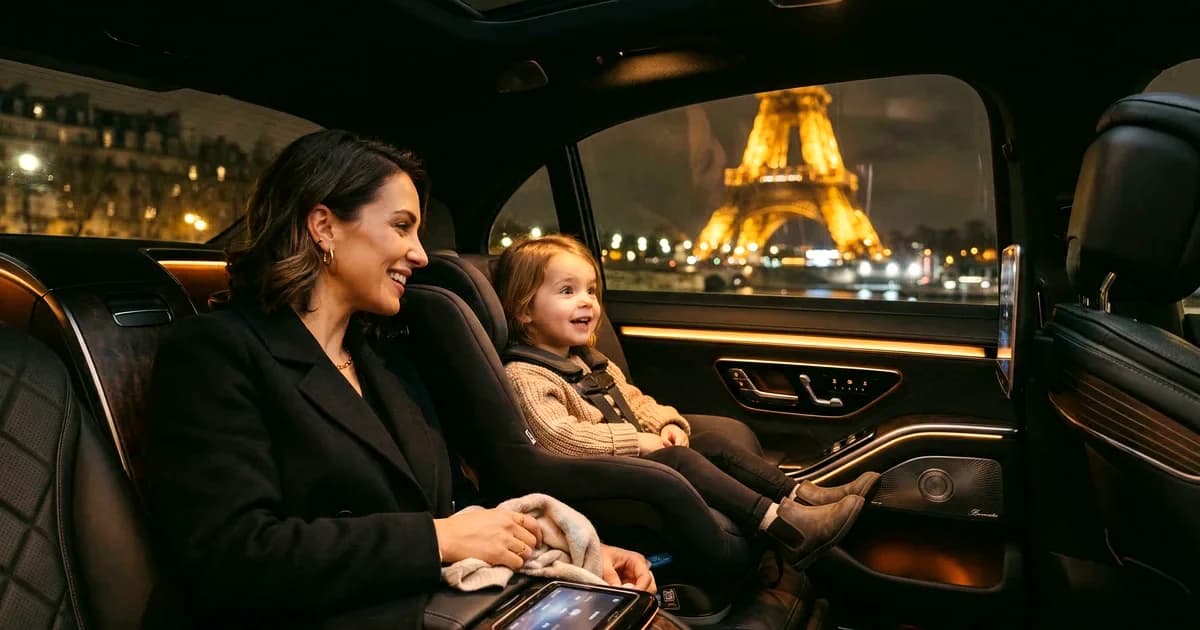
In France, children under ten generally need an approved restraint adapted to their build and weight, with regulated exceptions. Service Public explains the child-seat rules. Give the operator each child’s age, height and weight so the equipment can be confirmed before pickup.
The taxi exception in article R412-2 is not limited to a taxi hailed without a booking. It does not extend to VTC services. An exemption does not supply a suitable seat: arrange the required equipment explicitly with the operator.
| Information to provide | What to confirm |
|---|---|
| Age, height and weight | Approved restraint suitable for this child |
| Seat model, if you bring one | Compatibility with the assigned vehicle and installation instructions |
| Passengers, luggage and pushchair | Enough seats and luggage space with the restraints installed |
Which CDG Terminal, and Where the Car Actually Waits
Check the actual arrival terminal with the airline and follow the meeting instructions for your booking. Terminal allocation can vary by flight; an airline’s name is not enough to select the pickup point. PrivateDrive meetings take place at the agreed publicly accessible point after border checks and baggage. Contact the team if the terminal changes or you cannot find the chauffeur.
Knowing the terminal before you fly is what turns a confused thirty minute search into a short walk. A good operator sends the exact meeting point by message before you board, with a driver already tracking the flight. The difference between the halls, and why it changes the transfer, is set out in our guide to which CDG terminal you actually need. With small children, the terminal is not trivia. It is the difference between meeting your car in five minutes and hunting for it in thirty.
Four Ways into the City, Ranked by How They Treat a Pushchair
There are, in theory, four ways from CDG into central Paris. For a family with a pushchair, checked bags and a tired toddler, they are nowhere near equal.
The RER B is the fast train, and for a solo traveller with a backpack it is the obvious answer at roughly €14 on the airport ticket. With a family it collapses. The route runs through unreliable escalators and narrow turnstiles that will not pass a pushchair and a suitcase at the same time, and at rush hour it is standing room only. The express train travellers keep asking about, the CDG Express running direct to the centre, does not solve this either, for the simple reason that it does not exist yet: its first passengers board on 28 March 2027. For any trip before then it is not an option, however often it still appears in older guides.
The taxi rank is the reflex choice, and a fair one for adults, at a flat €56 to the Right Bank and €65 to the Left, fixed by decree and unchanged by the hour. For children it carries the flaw already described: no seat, and no exemption worth taking. Rideshare apps stack a further variable on top, since the car that turns up is whatever accepted the job, with no guarantee of a seat and a fare that climbs when arrivals cluster. The pre-booked private car is the only one of the four built around the family, with seats fitted before the driver leaves for the airport, a boot sized to the bags and the buggy, and a fixed fare quoted before you fly. What that fare should be across every transfer type is laid out in our guide to what a Paris transfer should actually cost.
| Option | Child seat | Pushchair, bags, two kids | What it costs |
|---|---|---|---|
| RER B train | None | Escalators and turnstiles, not realistic | About €14 per adult |
| Taxi from the rank | None, legal but not safe | One sedan, boot-limited | €56 Right Bank / €65 Left Bank |
| Rideshare app | Not guaranteed | Whatever vehicle accepts | Variable, surges at peaks |
| Pre-booked private car | Included, every age | Sedan or V-Class, sized to the family | From €125 CDG, €105 Orly |
What the Booking Actually Needs to Know
A family transfer is only as good as the detail it is booked on, and the seat is the part that cannot be improvised on arrival. Give the operator the number of children and each one's age, with the infant's approximate weight, because a rear-facing carrier for a newborn is a physically different object from a toddler's forward seat and the two are not interchangeable. Say how many bags there are and whether the pushchair folds small or stays bulky; a family of four with two young children usually needs a V-Class or a large estate for three or four cases plus the buggy. Name the terminal, add the flight number so the car can track the landing, and book a day or two ahead rather than four hours out, so the right seat is fitted rather than found.
The flight number does more work than it looks. It is what lets the car move with the aircraft rather than the schedule, so a delay in the air becomes the driver's problem and not yours. Exactly how much that matters when things slip is the subject of our account of what happens when your flight lands three hours late, and with children asleep in your arms it matters more, not less. The welcome that follows, a named driver waiting past the barrier rather than a rank to join, is covered in what airport meet and greet actually includes.
The Disneyland Question Every Family Asks
More families ask about this one route than any other, and the arithmetic is worth stating plainly. Charles de Gaulle to Disneyland Paris, out at Marne-la-Vallée, is around 35 kilometres on the A104 and forty to fifty minutes by car. The train alternative is the RER B to Châtelet and then the RER A back out to the park, an hour and a quarter with a change in the middle, made with luggage and children after a long flight. A direct car erases the change and pulls up at the hotel door with the seats still fitted. For a family landing tired and heading straight for the park, the case for driving it is less about comfort than about removing the one transfer most likely to end in tears on a station platform.
The seat is not an upgrade. It is the law, and on a motorway with a sleeping toddler it is the thing standing between a sudden stop and a hospital. That is the quiet logic under all of this: the first hour of a family holiday should subtract stress rather than add it, and almost everything that goes wrong in that hour traces back to a decision left until the arrivals hall. A car booked to the flight, with the right seats fitted and a driver holding a board, turns the worst hour of the trip into its easiest. As the case for why the arrival sets the tone for the whole trip puts it, the state you walk into the city in tends to become the state the holiday takes on. With children, that is not a luxury argument. It is the difference between starting the trip rested and starting it already behind.
Book a Paris family airport transfer with PrivateDrive. Infant carriers, child seats and boosters fitted with any charge confirmed in the quote, real time flight tracking, a named driver waiting in arrivals, and a boot with room for the bags and the buggy. Fixed fares from €125 at CDG and €105 at Orly, requested seats and luggage configuration to confirm.
Related Destinations
Related Articles
Paris Airport Transfer with a Baby: Car Seat Rules
transferts-aeroportParis Summer Airport Transfer: July and August 2026
transferts-aeroportDelayed Flight CDG Transfer: What Your Chauffeur Does
excursions-destinationsBest Day Trips from Paris: A Chauffeur's Ranking (2026)
lifestyle-luxe72-Hour Paris Itinerary by Private Chauffeur
lifestyle-luxeE-Class or V-Class for Your Paris Transfer
Also on this topic:CDG to Disneyland Paris: Train, Shuttle, Taxi or Car.