Key takeaway
Plan a Honfleur day trip from Paris by private car: the painters' harbour, the Étretat cliffs, Norman oysters, and the coast on your own clock.
No other day trip from Paris arranges quite the same collision of the senses that Honfleur does. Salt air off the estuary, the smell of Calvados warming in a timber-framed bar, oysters cold enough to ache, and on every third easel around the harbour a painter still chasing the light that Eugène Boudin caught first. The town sits two hundred kilometres northwest of Paris, in a natural harbour at the mouth of the Seine, close enough to reach before the museums open and rich enough to fill the hours until they close.
The question that trails every Honfleur plan is whether the harbour alone repays the drive, or whether the coast on either side of it deserves the day. The honest answer is that Honfleur earns the journey on its own, and then the Côte Fleurie to the east and the chalk cliffs to the west quietly double the reason for going. Doing that stretch of shore justice in a single day, harbour and cliffs and oyster stall, is where the way you arrive starts to matter more than the distance on the map.
The Harbour the Painters Never Left
Honfleur is not a reconstructed set. It is a working Norman port that history happened to spare: never bombed flat, never scrubbed into a theme park. The Vieux Bassin, the old inner harbour, is walled on three sides by houses six and seven storeys tall, faced in slate and timber, doubling themselves in the still water. The fourth side is the Lieutenance, the sixteenth-century gate that once controlled who came into the port. The weight of real age is the thing you feel before anything else.
The Eugène Boudin Museum carries the name of the town's own painter, the man who dragged a teenage Claude Monet out of the studio and into the open air to paint the sky as it actually behaved. Boudin's cloud studies, great smudged pastels of the Normandy heavens, are among the most underrated things in any French regional collection. It is the same estuary light, and much the same argument about painting outdoors, that later drew Monet upriver to the water garden now preserved at Monet's gardens at Giverny. Honfleur is where the coast first taught the Impressionists to look.
A few streets back, the Église Sainte-Catherine breaks every rule you expect of a French church. The town's shipwrights built it from timber rather than stone, which makes it the largest wooden church in France, its twin nave rising like two upturned hulls. The bell tower stands apart across the square, kept away from the body of the church for fear of fire and the weight of the bells. Nothing else in France is quite put together this way.
The Coast on Either Side: Cliffs West, Casinos East
A driver lets you treat Honfleur as the middle of a coast rather than the end of a road. An hour west, the chalk of the Côte d'Albâtre rears out of the Channel at Étretat, the arches and the needle that Monet painted obsessively through the 1880s. The clifftop path above the Porte d'Aval is still one of the great short walks in France, twenty minutes for a view that has launched a thousand canvases. What changed recently is the ground rules. After years of overtourism, close to two million visitors a year crowding a town of some twelve hundred residents, Étretat now bars passage beneath the arches at the base of the cliffs, has pulled out its clifftop car park to break the drive-up-and-selfie habit, and fines trespass from thirty-five euros. The view from the top is free and unchanged. The scramble below the arch is over.
Twenty minutes the other way, east across the Touques, the register flips from medieval to Belle Époque. Deauville is all boardwalk and parasols and half-timbered casino; Trouville, its older twin, keeps a working fish market on the quay and the earthier charm the painters found first. A plateau of oysters on the Trouville quay makes a natural bookend to a Honfleur morning, and the two resorts carry a full itinerary of their own, laid out in our guide to Deauville and Trouville by private car.
The Norman Table, and a Two-Star Kitchen Reborn
Normandy sets one of the richest tables in France, and Honfleur is where it reaches the sea. The pastures inland give Camembert, Livarot, and Pont-l'Évêque; the orchards give cider and Calvados; the cold water offshore gives oysters, mussels, and sole. Around the Vieux Bassin the terraces serve Normandy oysters the year round, plump and briny and cold, best met with a glass of dry cider or Muscadet. The mussels come steamed in cider or cream, the supply chain barely forty kilometres long, which is why the standard almost never slips. After the meal comes the Calvados, the apple brandy aged in oak out in the orchards, taken neat or as the trou normand, a cold measure poured between courses to reset the appetite.
The town's most storied kitchen has just written a second act. Alexandre Bourdas held two Michelin stars at SaQuaNa on the Place Hamelin for a decade, then closed the fine-dining room after 2020 and reopened the address as something deliberately more democratic: an all-day table and bakery, open Wednesday to Sunday, built on the idea that serious cooking should not be rationed to the few. The guide now lists it as a Bib Gourmand rather than a two-star, which tells you the ambition moved rather than left. For a harbour lunch it is the more interesting story, and a good deal easier to book than the shrine it used to be.
The Camembert worth carrying home is not made in Honfleur but in the Pays d'Auge inland, about forty minutes south through the orchards. If the route runs that way, a stop at a farm fromagerie for a raw-milk AOP round is one of those detours a fixed itinerary would never permit and a private day absorbs without a thought.
The Drive: Paris to Honfleur over the Pont de Normandie
The road west runs the A13 out through Versailles, past Rouen, the old Norman capital on the Seine, and reaches the coast over the Pont de Normandie, the cable-stayed bridge thrown across the mouth of the estuary. The crossing is part of the day rather than a detail of it: two point one kilometres of deck, fifty-two metres of air beneath it at the centre, the Seine going silver on both sides as the last of the motorway falls away. Honfleur sits five minutes past the toll plaza on the far bank.
| Leg | Distance | Drive time (off-peak) |
|---|---|---|
| Paris (8th) to Rouen | 135 km | 1 hr 20 min |
| Rouen to Pont de Normandie | 65 km | 40 min |
| Pont de Normandie to Honfleur | 5 km | 8 min |
| Total: Paris to Honfleur | 205 km | ~2 hr 10 min |
Leaving Paris before eight clears the western approaches before the A13 thickens, and turns a two-hour-ten run into the quiet start the day deserves. Normandy sits near the top of the best day trips from Paris ranked by a local chauffeur precisely because the reward scales with the effort of getting there, and the effort is what a chauffeur removes.
What a Chauffeur Adds on the Côte Fleurie
The case for a driver on this coast is written in its car parks. Honfleur's success has left the old town with almost nowhere to leave a car; in summer the surrounding lots fill by half past ten and the lanes gridlock. Étretat has gone further and removed its clifftop parking outright, so the drive-up shortcut no longer exists and the paid lots now sit a long walk from the cliffs at seven euros fifty and up. A private car dissolves both problems at once: it sets you down at the harbour mouth or the foot of the cliff path and repositions itself, and the question of where to park never reaches you.
A driver also opens the roads a rental map hides. The scenic return along the Côte d'Albâtre, chalk on one side and the Channel on the other, costs perhaps forty-five minutes over the motorway and buys the best driving on the whole coast. The A13 and Pont de Normandie tolls are handled without a word, an orchard view or a roadside fromagerie is a matter of pulling over, and if a single day starts to feel thin against the distance the same car reaches on to Mont-Saint-Michel when a day becomes two.
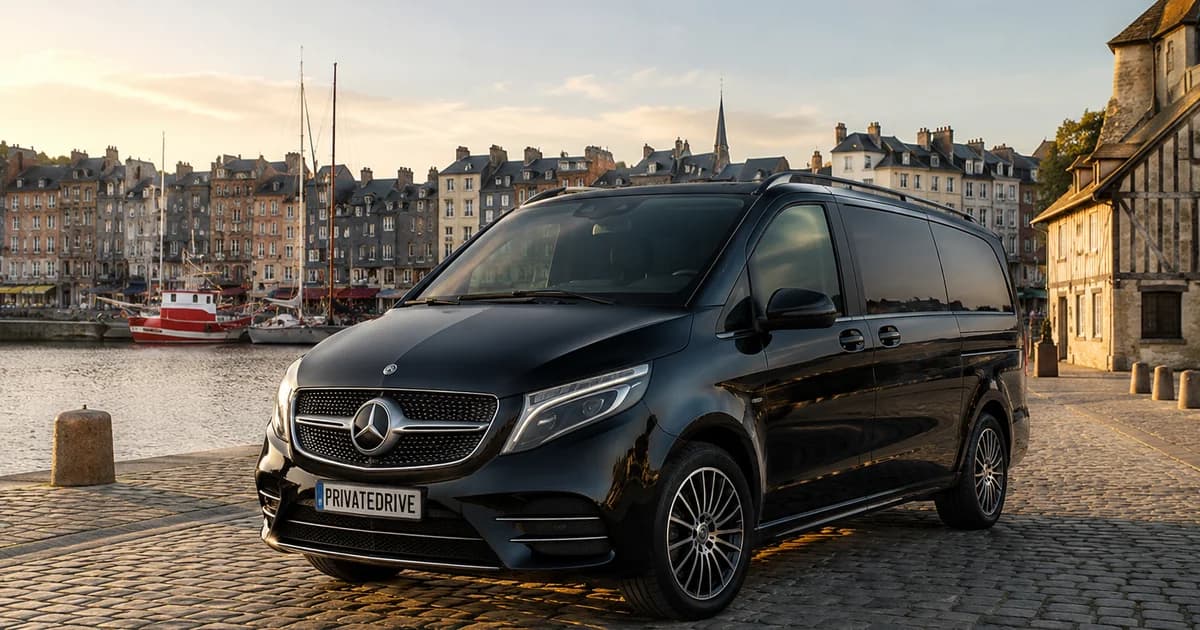
For a PrivateDrive day in Honfleur and the Côte Fleurie, request a quote for your date, route, stops and reserved duration. An E-Class carries up to three passengers; for four people, choose a suitable larger vehicle such as a V-Class and confirm space for luggage. Calculate any per-person comparison from that vehicle’s actual quote and passenger count. Waiting is covered within the booked period; confirm inclusions and any extension before agreeing to it. Our private transport pricing guide explains how to compare the offer.
Why the Coast Rewards the Ones Who Arrive Slowly
Honfleur has been painted more or less without a break for a hundred and seventy years, and the reason is not only the harbour. It is the light, which on this coast is the entire performance: the estuary haze lifting off the Vieux Bassin at nine, the chalk of Étretat going white then gold through the afternoon, the tide sliding back over the Trouville flats as you turn for home with the sky burning out behind you. That light keeps no timetable, and it does not wait for the last train.
What a private day on the Côte Fleurie really buys is the freedom to stay inside that light until it is finished. The harbour without the parking, the cliffs without the scramble, the oysters without the clock, and a road home taken at the hour the coast looks best rather than the hour a schedule allows. The distance was never the point. People have been making this drive for the same reason since the first painters carried their easels west: to be on the coast when it turns to colour, and to let someone else watch the road.
Request your PrivateDrive itinerary for Honfleur and the Côte Fleurie. Provide the pickup, stops, return time, passengers and luggage so the team can confirm the vehicle, duration and price. Any extra time requires availability and the applicable extension terms.
Practical Information
Musée Eugène Boudin
Hours
- High season (Jul to Aug)
- Daily exc. Tue, 10:00 to 13:00 and 14:00 to 18:00
- Rest of year
- Daily exc. Tue, mornings and afternoons
Prices
- AdultAround €8 (free under 16)
Falaises d'Étretat
Hours
- Clifftop paths
- Open access, free
- Below the arches
- Passage now prohibited
Prices
- ParkingPaid lots from €7.50
Last updated: 2026-07. Please verify on official websites before your visit.