Key takeaway
Plan a D-Day beaches private tour from Paris in 2026: drive times, the key sites, Pointe du Hoc and Bayeux updates, and the cost of a chauffeur day.
On 6 June 1944, around 150,000 Allied soldiers crossed a grey Channel and waded onto five Normandy beaches. Within a day the liberation of Western Europe had a foothold; within three months it had a front. The beaches still carry their code names, Utah, Omaha, Gold, Juno and Sword, and they remain among the few places where a landscape and its history sit so completely on top of each other.
The difficulty for a visitor is not emotional but practical. The landings did not happen at one spot. They unfolded along close to ninety kilometres of coast, and the sites worth seeing, a cemetery here, a battery there, a town inland, are strung across that whole arc. Public transport threads through it slowly and on someone else's timetable. A private car turns a scattered map into a single, unhurried day.
Two of the most-visited stops have also changed since the last edition of most guidebooks, in ways that decide how a 2026 itinerary should be built. That is reason enough to plan the day deliberately rather than follow a coach.
The drive west, and why an early start earns its keep
Paris to the Normandy coast is a run of roughly 240 to 280 kilometres depending on which beach you aim for, almost all of it on the A13 past Rouen. The road is fast and unremarkable, which is the point: the distance is best spent gaining ground while the day is young, not negotiating it on the way home in the dark.
| Destination | Distance from Paris | Drive time |
|---|---|---|
| Rouen (gateway) | 136 km | about 1h20 |
| Caen (base) | 241 km | about 2h10 |
| Bayeux | 274 km | about 2h25 |
| Omaha Beach | 280 km | about 2h30 |
| Pointe du Hoc | 285 km | about 2h35 |
| Utah Beach | 310 km | about 2h50 |
The arithmetic of a good day is simple. Leave Paris by 7:00 in the morning and the first site comes into view around 9:30, ahead of the coaches. Five to six hours on the ground covers three or four places without rushing any of them, and a mid-afternoon departure puts you back in Paris by eight. It is a long day by any measure, and it is part of why Normandy ranks so high among the best day trips from Paris: the payoff is proportionate to the effort.
There is also a version that never touches central Paris. A traveller landing at Charles de Gaulle can be driven straight to the coast, about 245 kilometres and two and a half hours from the terminal, which suits anyone arriving in the morning with the energy for it. The booking runs on the same fixed-fare basis as any other transfer, so the price is settled before wheels turn rather than metered against the traffic.
The American sector: Omaha, the cliffs, and the cemetery
Omaha Beach and the American Cemetery
Omaha is the emotional centre of almost every visit, and the reason is held in a single statistic: close to 2,500 American soldiers were killed here in a matter of hours on the morning of 6 June, pinned on open sand by German positions in the bluffs above. The beach today is wide, pale and quiet, used by dog walkers and sand yachts. The gap between that calm and what happened is exactly what makes standing on it worth the drive.
Above the beach at Colleville-sur-Mer, the Normandy American Cemetery holds 9,388 graves on an immaculate headland, white marble crosses and Stars of David in long unbroken rows. Admission is free and the visitor centre is excellent; an hour inside it turns a walk among the names into something closer to comprehension. It opens daily from nine to five and closes only on 25 December and 1 January.
Pointe du Hoc, open but under restoration through 2027
Between Utah and Omaha, U.S. Army Rangers scaled cliffs of nearly thirty metres under fire to silence a German battery that threatened both beaches. The ground has been left as the bombardment shaped it, a cratered moonscape of broken concrete and bunkers, and no other site conveys the physical violence of the day so directly.
It comes with a caveat for 2026. The American Battle Monuments Commission began an eighteen-month restoration of the site in February 2026 to fight coastal erosion and shore up visitor access, with work running into 2027. The promontory stays open throughout, but on adapted routes: the visitor centre closed on 9 March 2026, and access to parts of the bunker network and the western path tightened from mid-May, with parking reduced. The view and the craters remain; some of the walking does not. It is worth confirming what is reachable on the day you go.
Utah Beach and Sainte-Mère-Église
Utah saw a fraction of Omaha's losses, closer to 200 than 2,500, partly because a navigational error put the first waves ashore on a thinly defended stretch. Its museum, built into the original dunes around a captured bunker, is one of the best on the coast. Inland sits Sainte-Mère-Église, the first French town freed on D-Day and the place where paratrooper John Steele caught his canopy on the church tower and hung there through the fighting. A model still dangles from the steeple, and the Airborne Museum opposite tells the wider story of the night drop.
The British and Canadian beaches most day trips skip
Itineraries from Paris lean heavily American, understandably, but the eastern half of the invasion front has stops that reward the detour and tend to be quieter. Gold, Juno and Sword fell to British and Canadian divisions, and the engineering that kept the whole invasion supplied sat among them.
At Arromanches, on Gold Beach, the rusted caissons of a Mulberry Harbour still stand offshore. These were prefabricated ports, built in Britain and floated across the Channel, and through them passed something like 2.5 million men, half a million vehicles and four million tonnes of supplies in the hundred days after the landings. On the cliff above, the Arromanches 360 circular cinema runs a roughly twenty-minute film of archival footage across nine screens; its entrance hall was redesigned for the latest anniversary season and it stays open through 2026.
A short drive east, the British Normandy Memorial opened above Gold Beach at Ver-sur-Mer in 2021 and records more than 22,000 names of those who died under British command in the campaign. At Courseulles, the Juno Beach Centre tells the Canadian story, too often left out of a single day. Neither draws the crowds of Colleville, which is part of why they land so hard.
Bayeux, the base town, and the tapestry that left in 2026
Bayeux makes the natural base for the coast. It was the first town liberated after the landings, on 7 June 1944, and almost uniquely it came through the war undamaged, so its cathedral and medieval lanes are genuinely old rather than rebuilt. On its edge, the Bayeux War Cemetery holds more than 4,600 Commonwealth graves, the largest of its kind in France, with a German plot among them.
One long-standing reason to stop in Bayeux is, for now, absent. The Bayeux Tapestry, the seventy-metre eleventh-century embroidery of William the Conqueror's 1066 invasion of England, has left town. Its museum closed in September 2025 for a two-year rebuild, and the tapestry itself goes on show at the British Museum in London from 10 September 2026 to 11 July 2027, the first time it has crossed the Channel in nearly a thousand years. The new Bayeux museum is due to reopen in 2027. Plan for the town and the war history; do not build a 2026 day trip around seeing the tapestry, because it is not there.
What a chauffeur changes, and what the day costs
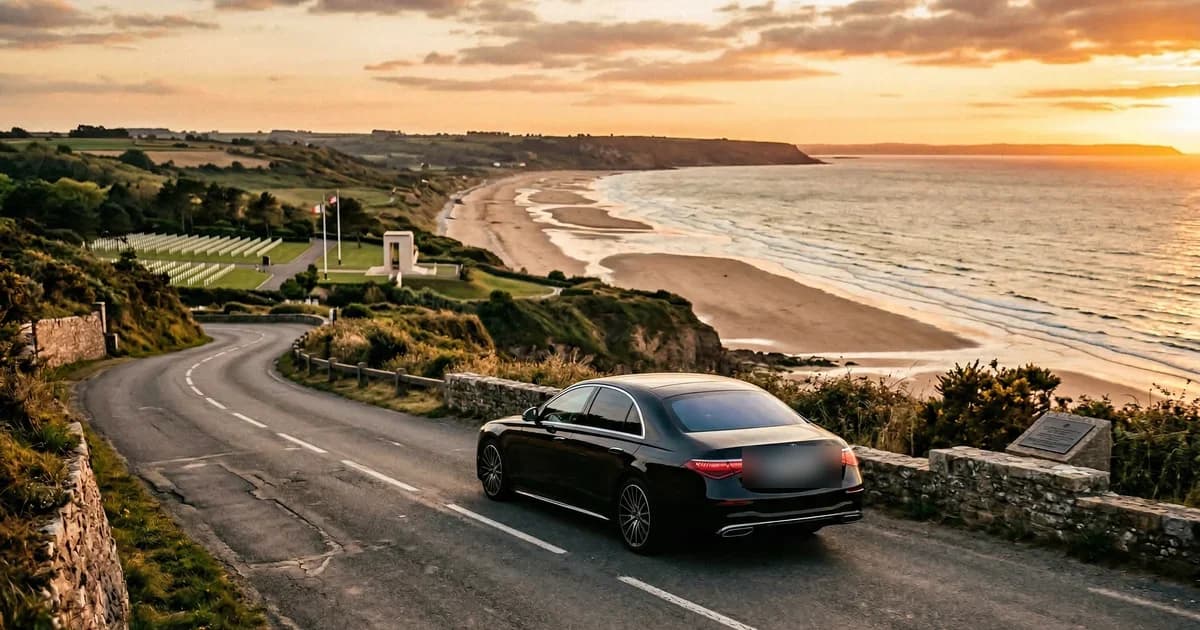
The case for a private car is not comfort for its own sake, though five hours of driving in a Mercedes is a different thing from five hours in a coach. It is control. You decide that Omaha deserves two hours and Arromanches twenty minutes, or the reverse. There is no group of forty to herd back to a car park, no fixed shuttle to catch, no stranger's reflection to navigate while you are trying to read 9,388 names. A driver who knows the parking and the back roads removes the friction a self-drive day spends its energy on.
It also scales cleanly. A couple takes an E-Class; a family or a small group travelling together takes a V-Class without anyone perched on a folded seat. Either way the price is per vehicle and fixed at booking, which on a long rural day with tolls and hours of waiting is worth more than it looks.
A full-day private Normandy excursion with PrivateDrive starts from €1,300 in a Mercedes E-Class for up to three passengers, €1,700 in a V-Class for up to seven, and €2,050 in an S-Class, each inclusive of motorway tolls and every minute of waiting at the sites. Set against a shared coach tour at €150 to €200 a head, the private day costs more in total and almost always less in everything that is not money: time, pace, and the quiet to take it in. Two or three people splitting a fixed fare close much of the gap on price alone.
Planning the day, and what to pair it with
May to September gives the best weather and the longest light; late September keeps the warmth and loses the crowds. The sixth of June brings the commemorations, the 82nd in 2026, which means ceremonies, veterans and a genuine charge in the air, alongside the traffic and closures that come with them. Whenever you go, pack shoes for uneven ground and a layer more than Paris suggests, because the coast is cool and the wind off the Channel rarely rests.
Some sites now run timed entry in peak months, the American Cemetery visitor centre among them, so a little pre-booking earns a smoother day; a good operator's concierge will handle it. If one day is not enough, an overnight opens the western end, Mont-Saint-Michel another 120 kilometres on, or the harbour town of Honfleur about fifty kilometres back toward the Seine. And because Monet's garden at Giverny sits almost on the return line to Paris, a one-hour detour can close the day on colour rather than concrete.
The mistake is to treat Normandy as a checklist of beaches to be cleared before dark. What the day is really for is the opposite of efficiency: standing long enough at Colleville for the rows to stop being a number, walking the craters at Pointe du Hoc without a guide's clock running, letting the drive home stay quiet. A private car is simply what makes that pace possible. The same logic that says the way you arrive sets the tone for a trip applies, more seriously, here: the journey is not the overhead on the history. On this coast, it is part of it.
Plan your Normandy D-Day excursion with PrivateDrive. One car for the day, a driver who knows the coast and its car parks, fixed pricing confirmed before you leave Paris, and a schedule that bends to the sites that hold you longest.
Practical Information
Mémorial de Caen
Hours
- Apr – Sep
- 9:00 AM – 7:00 PM
- Oct – Mar
- 9:30 AM – 6:00 PM
- Annual closure
- Early January
Prices
- Adult€20.80
- Child (10–18)€18.50
- Under 10Free
Normandy American Cemetery
Hours
- Daily
- 9:00 AM – 5:00 PM (admission ends 4:30 PM)
- Closed
- Dec 25 & Jan 1
Prices
- AdmissionFree
Pointe du Hoc
Hours
- Site, daily
- 9:00 AM – 5:00 PM (12:30 – 1:30 PM break in winter)
- 2026 restoration
- Visitor centre closed; west pathway only since mid-May 2026
Prices
- AdmissionFree
Last updated: 2026-06. Please verify on official websites before your visit.
Related Destinations
Related Articles
Honfleur Day Trip from Paris by Private Car
excursions-destinationsNormandy D-Day Weekend by Private Chauffeur for Families
excursions-destinationsVersailles by Private Car: The Insider Guide
excursions-destinationsChampagne Route: Reims & Épernay by Private Driver
lifestyle-luxe72-Hour Paris Itinerary by Private Chauffeur
excursions-destinationsMont-Saint-Michel by Private Car from Paris: 2026 Day Trip
Also on this topic:Deauville Day Trip from Paris: Normandy by Private Car, Giverny by Private Car from Paris: The 2026 Day Trip Guide, Loire Valley by Private Car from Paris: 2026 Day Trip Guide.