Key takeaway
Compare chauffeur quotes in Paris, London and Dubai: VAT, congestion charges, booking conditions and the details that affect your final price.
Since 2 January 2026, qualifying UK private-hire journeys have been excluded from the Tour Operators’ Margin Scheme. HMRC explains which operators and supplies are affected. This does not mean every London fare rose by 20%. The customer impact depends on the previous tax treatment and the operator’s pricing.
No memo goes out to the person in the back seat. The quote simply reads differently, and the comparison between the three cities that international travellers rotate through moved with it. What separates Paris, London and Dubai has remarkably little to do with the cars. It is fiscal and regulatory, and it decides two things that matter more than the badge on the bonnet: what the state adds to your fare, and whether the number you were shown before booking is still the number when you get out.
What the 2026 UK VAT change actually covers
The exclusion concerns qualifying supplies by operators acting as principal or in their own name. VAT registration and the actual contractual arrangement matter. A simple illustration keeps the arithmetic clear: £200 excluding VAT becomes £240 at 20%; a £200 VAT-inclusive fare contains £33.33 of tax. These are two different starting assumptions, not a before-and-after price observation.
Whether an operator absorbs a tax change or changes its customer prices is a commercial decision. Compare the total on a dated quote rather than treating a tax rate as a measured fare increase.
The TfL congestion charge moved in the same window. Frozen at £15 since 2020, it is now £18 on the day and £21 for anyone who pays in the three days after travelling. Black cabs are exempt from it and private hire cars are not. Electric vehicles had already lost their full exemption on 25 December 2025, when the Cleaner Vehicle Discount expired, and since 2 January they pay £13.50 under a 25 percent reduction conditional on registering for Auto Pay. The £12.50 ULEZ charge is a separate scheme that only touches vehicles below the emissions standard, so a premium London fleet running Euro 6 or electric sees none of it. Paris levies no daily toll of that kind at all, though its low emission zone filters which cars may enter, a distinction we unpack in a separate look at the Paris ZFE.
The transport contract determines the French VAT treatment
France applies the reduced 10 percent rate to passenger transport, and a chauffeured car falls inside it whenever the service is genuinely a journey. On a Charles de Gaulle transfer, tax is therefore one eleventh of the price you are shown. In London, at the full twenty percent, it is one sixth, and the gap is written into two tax codes rather than into two price lists.
A condition is attached, and knowing it changes how you should write the brief. The reduced rate holds when the arrangement is a genuine transport contract, which the tax administration reads from the terms as a whole: a destination fixed in advance, a price built on the route, the operator carrying responsibility for the vehicle. Billing by the hour with no itinerary is the classic indication that the arrangement has become the hire of a vehicle with a driver, taxed at 20 percent across the entire invoice. It is an analysis of the contract, not a switch flipped by the unit of billing, which is why the same car can sit in two different brackets on two different days. Where each structure lands is followed through in the guide to what a Paris transfer should actually cost.
Then the arithmetic reverses, and it reverses in the direction nobody expects. Article 206 of annexe II to the French tax code excludes passenger transport from the right to deduct. Subject to the statutory exceptions, an ordinary business customer generally cannot reclaim VAT on a taxi or chauffeured passenger journey, and books the expense inclusive of tax. The opposite applies across the Channel, where an eligible VAT-registered business may recover input tax on business travel against a valid invoice, subject to its VAT regime. If those recovery conditions are met, a London ride at £240 including 20% VAT has a £200 net cost, while a Paris transfer at €125 costs a French company €125. The private traveller pays less in Paris. The finance department that settles the invoice does not necessarily agree, because the French ten percent is money that never comes back and the British twenty percent is money that does.
For Dubai, check the tax treatment on the operator’s invoice. The Federal Tax Authority distinguishes local passenger transport and other transport supplies; a blanket 5% assumption is not enough to determine either the tax due or its recoverability.
Dubai added supply while Europe held still
The RTA’s 2025 results report 23.6 million passengers for Dubai’s luxury transport services, a 22% increase on 2024. This specific segment should be kept separate from wider taxi or public-transport totals when comparing markets.
Licence and permit frameworks differ between cities. A month-long chauffeur arrangement should be checked with the operator for the required authorisations, booked hours, vehicle and contract terms. The existence of a local permit does not establish that another city has no comparable commercial service.
The practical consequence for the passenger shows at the top of the range. A Rolls-Royce or a Bentley can generally be found in Dubai at short notice, while the Paris premium fleet is close to entirely Mercedes and a flagship marque is a request placed several days ahead.
How deep the supply actually runs
Transport for London’s licensing table records 94,623 private hire vehicles and 112,343 private hire drivers for the week ending 30 August 2026. These are licence counts, not vehicles or drivers simultaneously available to book. Comparisons with Paris or Dubai need a matching date and definition.
Volume at that scale is not a quality signal, and reading it as one is the standard mistake. London's depth is real at every tier, which is precisely why its mid-market is so uneven, since a licence count of that size and still growing cannot be curated. The French framework produces something else, which is a floor. Every legitimate operator is registered, every driver examined, and the distance between the best and the worst car you might be sent in Paris is narrower than in a market five times larger. How that floor is built is set out in a study of the Paris luxury ground transport market.
Whether the number can still move after you book
France settled this question a decade ago and has been tightening it since. The Thévenoud law of October 2014 separated taxis, which may be hailed in the street, from chauffeured vehicles, which may not pick up a passenger without a prior booking. Showing a client where an available car is before any booking exists is prohibited, and the Cour de cassation confirmed in June 2025 that simply displaying nearby available vehicles on a map is enough to constitute the offence, upholding €150,000 of damages against the platform that did it. The order of 6 August 2025 then fixed seven items that must appear on every booking voucher, among them the operator's registration number, the exact time the reservation was made and the pick-up point requested by the client. A missing or incomplete voucher is a €1,500 fine, €3,000 on a repeat within the year, and up to €15,000 if the check reclassifies the journey as illegal transport altogether.
Read as consumer protection instead of red tape, that machinery does something specific. It makes the price a commitment. A Paris quote is calculated on a date, an hour and a route, issued before you accept, and it does not recalculate itself while you walk to the car. No multiplier is watching how many people opened an app when a show came out. Travellers crossing the Channel see the contrast on the London leg, where availability and price both stay live until confirmation, and the Eurostar transfer on either side is the clearest place to watch the two systems run against each other on a single trip.
Private aviation is the one gap Paris has genuinely won
Le Bourget is dedicated to business aviation; London arrivals can use several airports. The relevant comparison is the actual arrival airport and FBO, the destination address and the road conditions. Airport statistics need matching periods and denominators before they can support a comparison.
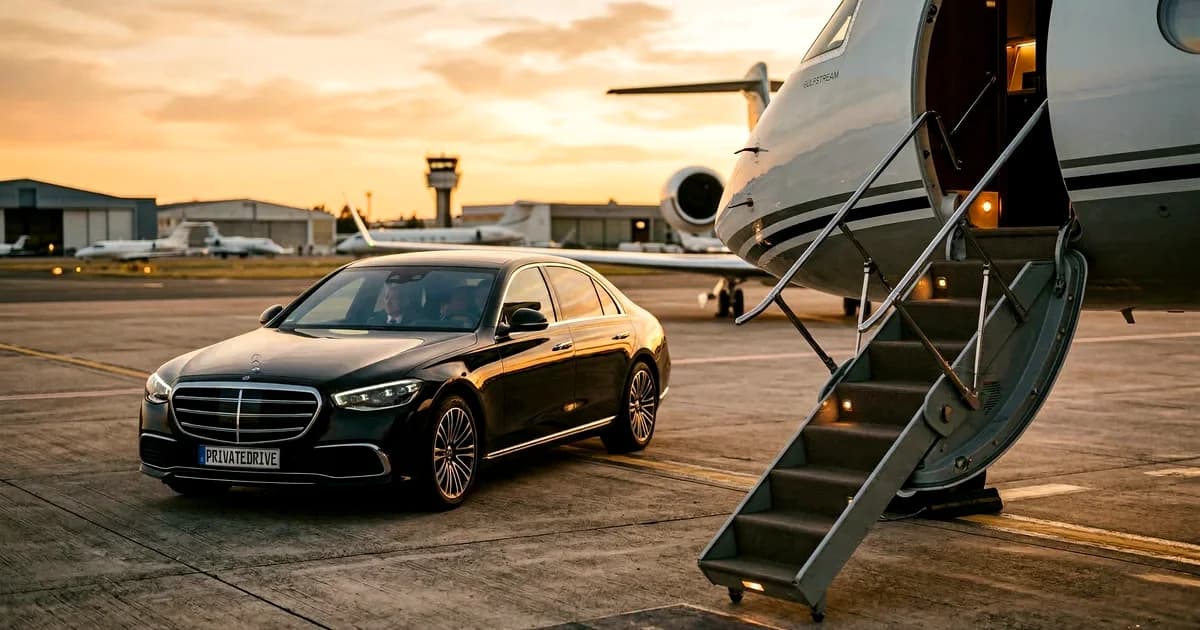
For a passenger arriving by private jet the difference is not prestige. It is minutes on the ground. One dedicated field close to the city, with customs on site and several fixed base operators, produces a shorter and far more predictable transfer than a choice between three airfields at three different distances, and the arithmetic holds even on a bad traffic day. That calculation, including the itineraries for which Charles de Gaulle beats Le Bourget, is worked through in a comparison of the two Paris options.
Dubai plays a different game entirely. Dubai International handled 95.2 million passengers in 2025, the highest international figure in the world, and its premium arrivals machinery was engineered around that volume instead of being retrofitted to it. Heathrow carried 84.5 million and Charles de Gaulle 72.03 million. Scale of that kind buys process, and the greeter operation at DXB is the most industrialised of the three.
The instinct is to rank the three cities and pick a winner, which is the wrong exercise, since they are not competing for the same booking. What January 2026 actually exposed is how much of a luxury transport price is decided in a parliament and not at an operator's desk. The UK VAT change and London’s £18 Congestion Charge affect some quotes, but neither establishes a universal fare increase. Dubai licensed 2,500 vehicles in a year and invented a permit for month-long chauffeured hire, because a state that wants a market can simply build one. France did neither, and spent a decade making the quote binding instead.
So the useful question is not which city is best but which of those three levers you are exposed to. A private traveller paying out of pocket is exposed to the rate, and the French ten percent wins on journeys, though not on hourly hire. A company reclaiming its input tax is exposed to deductibility, which quietly hands the advantage back to London. A passenger on a tight connection is exposed to neither, and cares only that Le Bourget is twelve kilometres from the city while Farnborough is a motorway away. Three questions, three answers, and only one of them is about the car.
PrivateDrive operates Paris on fixed rates confirmed at booking: €125 from Charles de Gaulle, €105 from Orly, €125 from Le Bourget, and hourly hire from €85/h. The price you are shown is the price on the invoice, whatever the app on your phone is doing that evening.