Key takeaway
How Paris law firms buy client transport: flight-tracked pickups, trained discretion, waiting without a meter, and the demand peak of ICC arbitration.
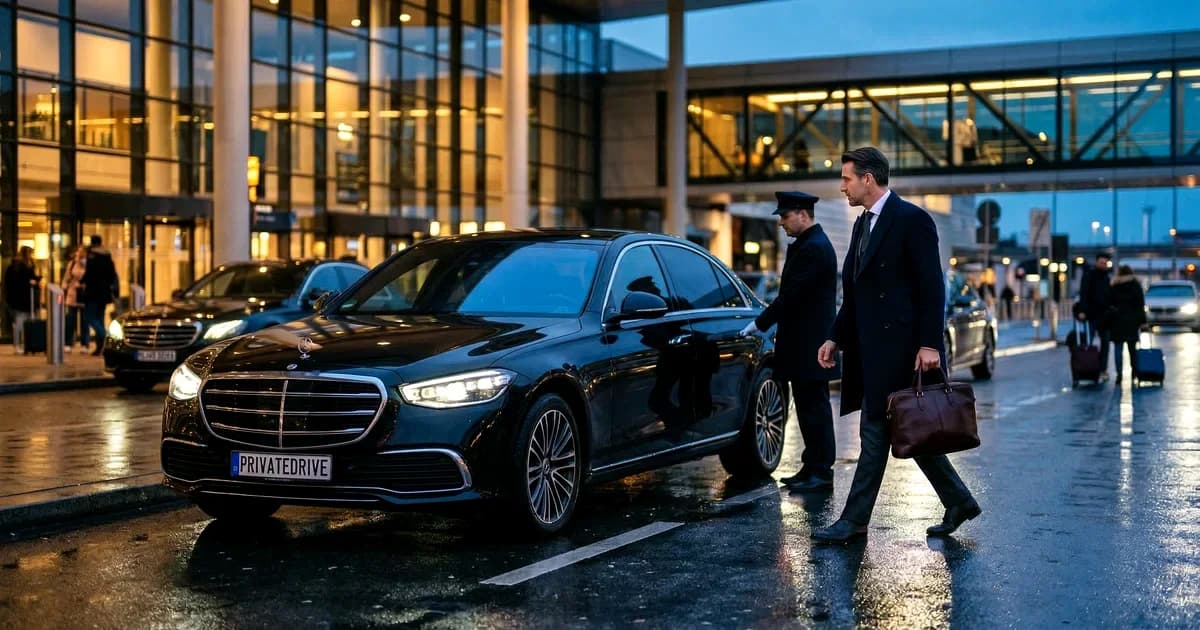
The signing is set for nine in the golden triangle. The counterparty’s CEO lands at CDG at 7:05 after a night over the Atlantic, and somewhere between Terminal 2E and the eighth arrondissement his frame of mind will be decided: rested or rattled, looked after or processed. The associate who drafted until two in the morning will never be seen. The car at the kerb will be. For the next forty minutes, it is the firm.
Serious Paris practices treat client transport accordingly: as procurement, not petty cash. The brief has little in common with ordinary corporate travel. Arrivals are international and volatile, schedules slip by hours rather than minutes, the matter stays confidential until it is announced, and the vehicle reflects on a letterhead that bills four figures an hour. Getting it right is a quiet discipline, and it begins with geography.
Firms Stayed Near Vendôme. The Courts Left.
Legal Paris is compact and old. International firms cluster along the axis that runs from Place Vendôme and Opéra into the eighth arrondissement, with a contingent of commercial practices out in the towers of La Défense. The map of their clients’ mornings, though, was redrawn in 2018, when the tribunal judiciaire left the Île de la Cité for Renzo Piano’s 160-metre tower at Porte de Clichy, the largest court complex in Europe. The historic Palais de Justice kept the Cour de cassation and the cour d’appel, with the commercial court sitting on the same island.
Arbitration pulls in yet another direction: the International Chamber of Commerce keeps its headquarters on avenue du Président Wilson in the sixteenth and holds hearings at its Hearing Centre on rue Legendre in the seventeenth, minutes from the new tribunal. A single live matter can now stretch across four addresses in three arrondissements, none of them a comfortable walk from the office. The era when counsel crossed the Pont Neuf on foot is closed; the timed cross-town leg has replaced it, and someone has to run those legs perfectly.
The Specification, Written and Unwritten
Start with arrivals that hold. Firms specify flight tracking as standard, so the driver is keyed to wheels-down rather than to an ETA printed on an itinerary three weeks ago. When a flight runs three hours late into CDG, the pickup slides with it, silently, without a chain of dawn emails between two time zones. Terminal knowledge belongs to the same requirement: 2G is a shuttle ride from 2F, not a walk, and a driver who discovers that live, with a client watching, has already failed the brief.
Discretion comes next, and it is trained behaviour, not good intention. The deal is unannounced. The counterparty may be known to other clients. So a chauffeur on a legal account does not name his other passengers, does not confirm a booking to a caller claiming to act for the client, does not take calls on speaker while the car is occupied. Nothing about the passenger, the route or the destination leaves the vehicle. Firms write confidentiality undertakings into transport agreements for the same reason they write them into everything else: goodwill without training leaks.
Then there is waiting, the quietest line in the specification and the most revealing. Hearings overrun. Negotiations overrun by design, and walking out to feed a meter is not a bargaining posture. Per-minute waiting charges, the standard app economics, quietly pull the client toward the kerb at the moment the matter needs them at the table. Firms buy the opposite: the car on mise à disposition by the half day or the day, from €85/h, where presence is the product and the clock stops mattering. The client leaves the room when the room is done.
Presentation closes the list. E-Class as the floor, S-Class for partner-level and client work, V-Class when a delegation lands with luggage. A suited driver, a detailed interior, water and silence in equal supply. None of it is vanity. It calibrates the state of mind that walks into the meeting room, which is why the arrival sets the tone for everything that follows.
Signings, Data Rooms and Other Exercises in Choreography
Deal work generates transport problems ordinary travel never meets. A multi-party signing collects principals from three hotels and lands them at one address inside the same ten minutes: several cars, one coordinator, and the logic of moving a board from runway to boardroom in sixty minutes. Due diligence adds timed data room access, where a missed slot is a renegotiated slot. Court days add the oldest problem of the trade: an expert witness delivered to the right entrance of the right courthouse, then a car that waits through an afternoon nobody can schedule.
The operational answer is notice and structure. A city leg can be raised in a couple of hours. An airport collection wants a day. A signing with four simultaneous vehicles is planned like a small event, days ahead, with one phone number responsible for all of them. The firms that run this well keep a provider who answers at 6:40 on a Sunday morning, because closings have no respect for office hours.
Arbitration Made Paris a Transport Market of Its Own
The steadiest demand comes from disputes. Paris returned to first place among ICC arbitration seats in 2025: 82 new cases chose the city against 78 for London, out of 894 filings worldwide and a record 1,869 matters pending at year end, with an average of some fifty million dollars in dispute. Each Paris-seated case eventually becomes people in rooms. Arbitrators from three jurisdictions, counsel teams, witnesses and interpreters land at CDG, from €125 a transfer, or at Le Bourget, from €125, when the parties fly private.
Hearing weeks have a rhythm experienced firms buy in advance: fixed morning runs to rue Legendre, evening returns to the hotels, a car held through deliberation days. Every spring the calendar spikes again when Paris Arbitration Week, whose tenth edition ran from 23 to 27 March 2026, fills the city’s hearing rooms and hotel lobbies at once. Providers are block-booked weeks ahead of it. The firms scrambling for cars that week are the ones that treated transport as an afterthought the other fifty-one.
How the Buying Actually Runs
At international firms, ground transport is procured like any sensitive service: one preferred supplier, a written agreement, a tested backup. The agreement reads like a compact service-level contract and tends to cover the same ground:
- Vehicle classes and driver presentation, specified rather than assumed;
- Response times for city legs and for airport collections;
- A named account manager rather than a queue;
- Consolidated monthly invoicing with matter codes, so every journey lands on the file it belongs to and rebills cleanly;
- Confidentiality undertakings binding every driver who touches the account.
Smaller French cabinets buy the same standards with less paper: an office manager, one or two trusted providers, bookings made matter by matter. Either way the discipline pays for itself, because the real cost of unreliable corporate transport is never the fare, it is the signing that starts badly. The mechanics, from billing structure to service tiers, follow the pattern of a corporate ground transport account in Paris, tuned for the specific confidentialities of legal work.
Paris keeps raising the stakes on getting this right. One of the world’s largest law firms is now led from the city: when Allen & Overy and Shearman & Sterling merged in 2024, the combined firm’s global managing partner, Hervé Ekué, kept his base in Paris. The courts have scattered across the map, arbitration keeps refilling the calendar, and every one of those movements is, at street level, somebody’s car arriving on time or failing to.
A law firm sells judgment delivered by people at their best. Against the fees on a Paris matter, the transport line is almost invisible, and it is the only line the client physically sits inside. PrivateDrive runs corporate accounts built for legal practice: flight tracking on every collection, matter-code billing, drivers briefed on discretion as a duty rather than a courtesy. Talk to our corporate team about a law firm account, and the next signing morning will start the way it should: with a door held open, on time, by someone who knows nothing worth repeating.